

Emotional Anchors vs Logical Features
Why buyers decide with emotion first and justify with logic second — and how your book description must reflect that reality
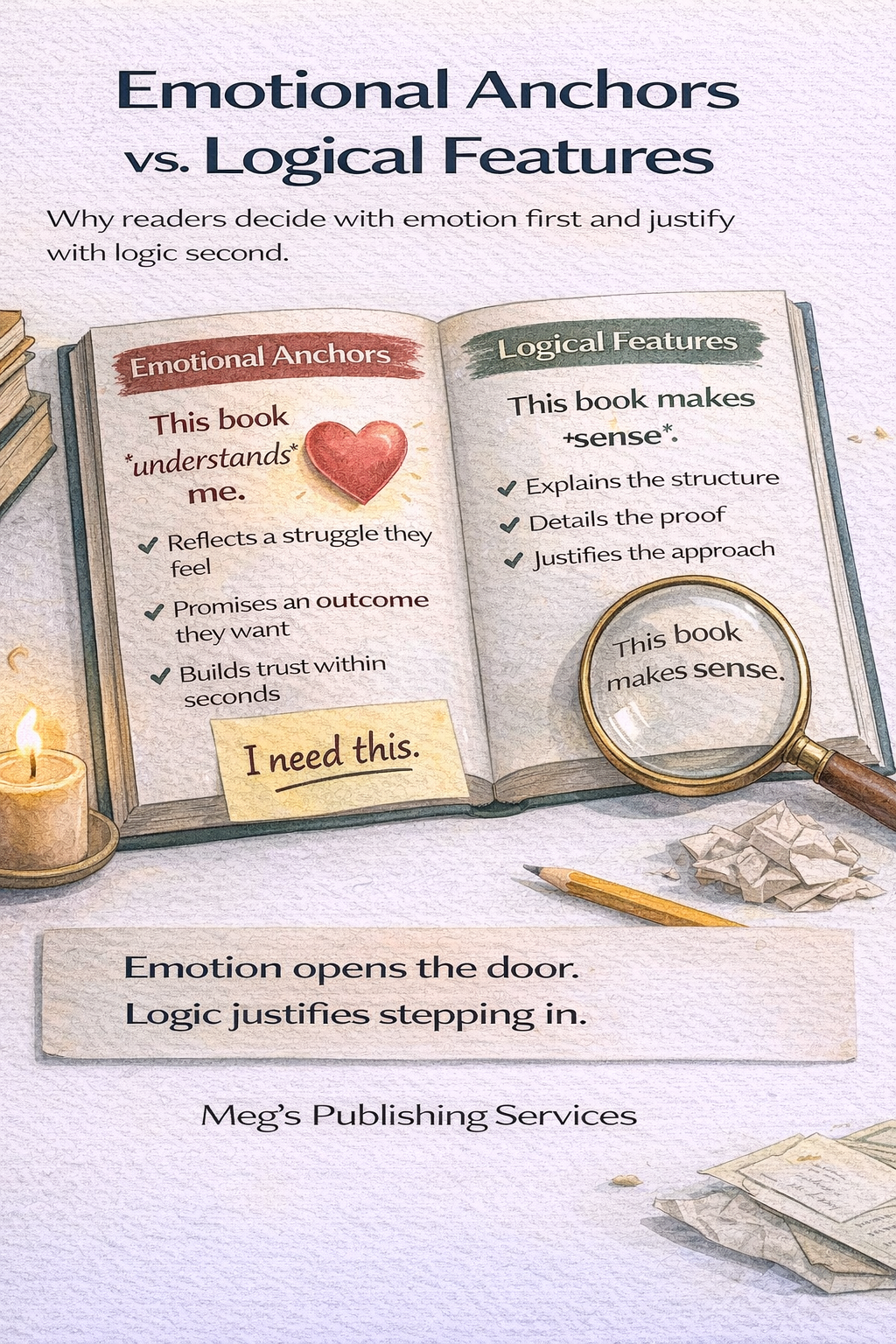
Most authors believe readers buy books because the argument makes sense.
The framework is solid.
The chapters are well structured.
The logic checks out.
But that is not why people click.
Readers buy because something in the description moves them first. The logic only comes in afterward to make the decision feel responsible.
Amazon’s marketplace is built around this truth. Many authors still write as if it isn’t.
The mistake authors keep repeating
Open most Amazon descriptions and you will see the same pattern.
They explain what the book covers.
They outline the structure.
They list features.
They justify the effort it took to write the book.
All logical. All reasonable. All ineffective at the wrong moment.
Because the reader did not arrive on your page to be educated. They arrived to decide whether this book is worth their attention right now.
Logic requires attention. Emotion earns it.
What readers are actually doing on your page
A reader scrolling Amazon is not sitting back with curiosity. They are moving fast, comparing options, and unconsciously asking one question:
“Does this feel like it was written for someone like me?”
That is an emotional question, not a logical one.
Before the reader cares how many chapters you have, they want to feel relief, recognition, or hope. They want to feel that the book understands their problem better than the others on the screen.
If that feeling does not arrive quickly, they move on.
Emotional anchors are not hype
This is where many authors misunderstand the concept.
An emotional anchor is not exaggeration. It is not manipulation. It is not empty promise-making.
An emotional anchor is precision.
It names the reader’s frustration clearly.
It reflects the moment they are stuck in.
It articulates the tension they have not fully put into words.
When done well, it feels calm and grounded. The reader does not feel sold to. They feel understood.
That feeling creates trust faster than credentials ever will.
Why logic alone creates distance
Logical features feel safe to authors because they are factual. They are defensible. They feel professional.
But logic without emotion feels like work.
It asks the reader to analyze before they are invested. It demands effort before offering reassurance. And effort is something readers subconsciously avoid when they are overwhelmed, tired, or uncertain.
A description that leads with logic forces the reader to lean forward mentally. Most won’t.
They are not rejecting your ideas. They are protecting their energy.
Where logic belongs and why it still matters
Logic is not the enemy. It is the closer.
Once the reader feels emotionally anchored, logic becomes comforting. It reassures them that this book will not waste their time.
This is where structure works.
This is where methods matter.
This is where proof earns its place.
Logic answers the follow-up questions the reader did not even know they were asking yet.
Is this practical?
Is this credible?
Is this usable for me?
But logic only works after emotional alignment is established.
How Amazon responds to this sequence
Amazon tracks behavior patterns, not intentions.
When readers pause, scroll, and continue reading, Amazon interprets that as relevance. When readers bounce quickly, Amazon reads confusion or mismatch.
Descriptions that lead emotionally and support logically create longer engagement windows. They slow the reader down. They create micro-commitments.
Those signals compound quietly over time.
This is why some books seem to gain traction without aggressive marketing. Their descriptions align with how humans actually decide.
The deeper shift authors must make
Stop asking, “How do I explain this better?”
Start asking, “What does my reader need to feel first?”
Emotion opens the door.
Logic secures the decision.
Reversing that order weakens both.
A strong description is not louder.
It is more attuned.
It understands that people do not buy books to learn information. They buy books to change something about how they think, feel, or act.
When your description respects that truth, readers stay. And when readers stay, Amazon listens.