

Series Architecture: How Fiction vs Nonfiction Series Are Built Completely Differently
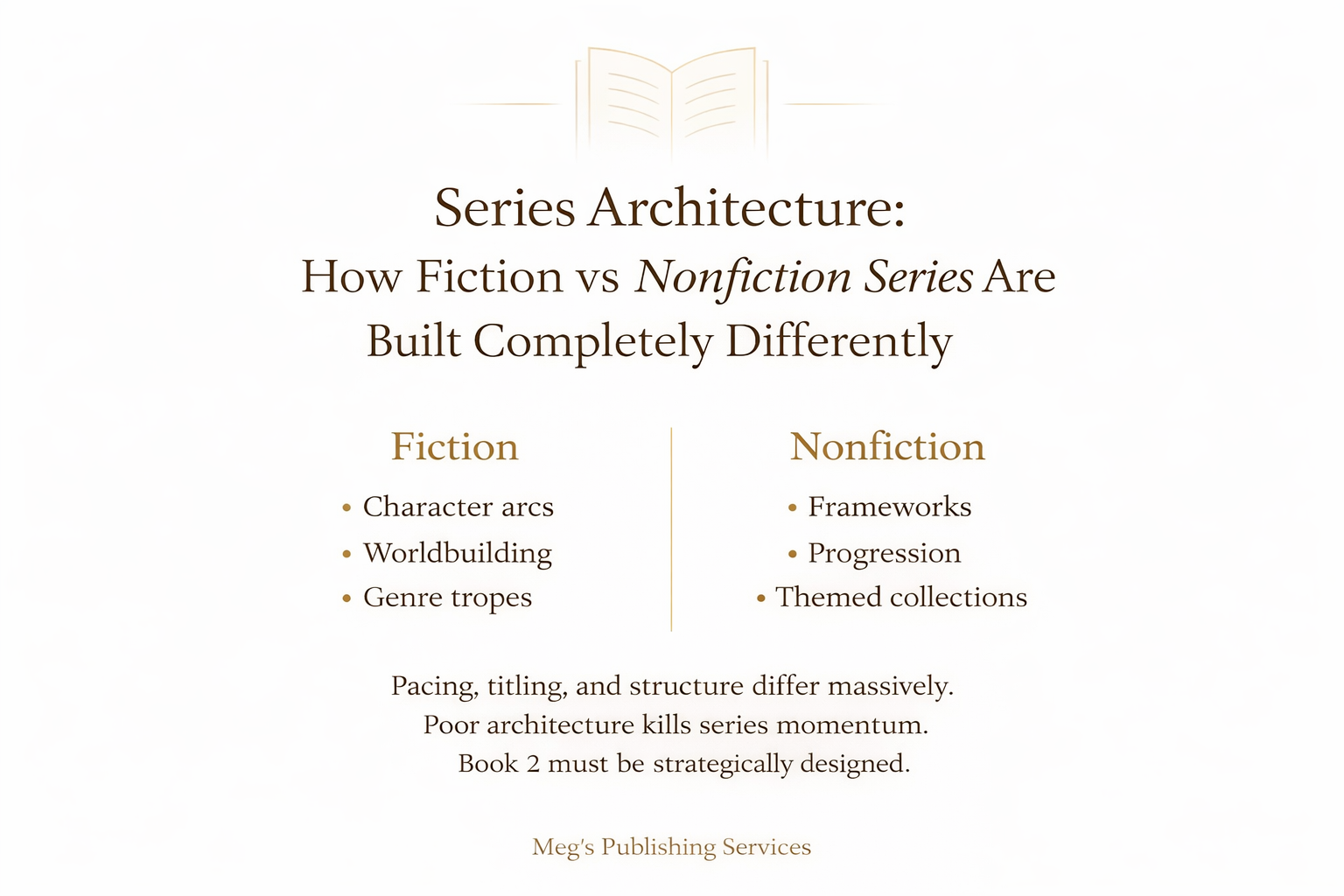
Here’s the truth most authors only realize after Book 2 disappoints them:
A book can sell on its own but a series is what builds gravity.
That gravity is what turns readers into repeat buyers, browsers into believers, and authors into brands.
Yet one of the biggest silent killers of author careers is this assumption:
“A series is just multiple books on the same topic.”
It isn’t. When authors treat it that way, momentum dies quietly.
Series Architecture: Why Fiction and Nonfiction Are Built on Entirely Different Blueprints
On the surface, fiction and nonfiction series look similar. Multiple books. Related themes. Familiar covers. Shared branding.
Underneath?
They run on completely different engines.
Fiction Series: Story Is the Spine
A fiction series is held together by emotional continuity.
Readers don’t return because of the topic.
They return because of attachment.
Characters evolve
Stakes escalate
Worlds expand
Tension compounds
Each book answers some questions while deliberately opening new ones.
This is why:
Character arcs must stretch across books, not reset
Worldbuilding deepens instead of repeating
Genre promises are honored consistently
Tropes are used strategically, not randomly
Book 2 in fiction isn’t “another story.”
It’s the next emotional payment on a promise already made.
When fiction series fail, it’s usually because:
The arc plateaued too early
The stakes didn’t rise
The author wrote sideways instead of forward
Readers feel that—even if they can’t name it.
Nonfiction Series: Structure Is the Spine
Nonfiction works the opposite way.
Readers aren’t emotionally attached to a character.
They’re attached to progress.
A nonfiction series succeeds when it creates a sense of movement:
From confusion → clarity
From awareness → application
From beginner → intermediate → advanced
That movement must be designed, not improvised.
Strong nonfiction series rely on:
Clear frameworks
Logical progression
Intentional levels or phases
Themed collections with a job to do
A nonfiction Book 2 should feel like:
“Of course this comes next.”
Not:
“Why does this exist?”
And yet, many nonfiction authors accidentally sabotage themselves by:
Repeating the same ideas with new titles
Rewriting Book 1 from a slightly different angle
Treating every book as standalone “value”
The result?
Readers buy one book… and stop.
Not because the book was bad—but because the path forward wasn’t clear.
Why Pacing, Titling, and Structure Matter More Than You Think
Here’s the uncomfortable truth:
Most series don’t fail because of marketing.
They fail because of architecture.
Pacing Problems
Fiction that resolves tension too early leaves nothing to chase
Nonfiction that gives everything in Book 1 leaves nothing to build toward
Titling Problems
Fiction titles that don’t signal progression confuse readers
Nonfiction titles that sound interchangeable kill urgency
If Book 1 and Book 2 could be swapped without consequence, you don’t have a series—you have a pile.
Structural Problems
No narrative escalation (fiction)
No skill ladder or outcome ladder (nonfiction)
When architecture is weak, Book 2 becomes invisible—even to readers who enjoyed Book 1.
How Poor Series Architecture Quietly Kills Momentum
This is the most dangerous kind of failure because it doesn’t look dramatic.
Book 1 sells decently
Reviews are okay
No obvious red flags
But:
Read-through drops
Algorithms don’t cluster the books
Readers don’t feel compelled to continue
The author feels like they’re “starting over” each time
That’s not a marketing issue.
That’s a structural one.
Series momentum isn’t generated by volume.
It’s generated by design.
Why Book 2 Is the Most Strategic Book You’ll Ever Write
Book 1 gets attention.
Book 2 decides your future.
Book 2 answers one brutal question:
“Is this author building something—or was that a one-off?”
In fiction, Book 2 must:
Deepen emotional investment
Complicate the central conflict
Prove the world can sustain tension
In nonfiction, Book 2 must:
Advance the framework
Move the reader to a new level
Clarify what mastery looks like beyond basics
When Book 2 is designed intentionally, readers don’t hesitate.
They follow.
The Shift That Changes Everything
There’s a massive difference between:
Writing books
andBuilding systems that produce books
Authors who think in series architecture stop asking:
“What should my next book be about?”
And start asking:
“What am I building readers through?”
That’s the difference between short-term sales and long-term relevance.
And it’s exactly why serious authors stop thinking in isolated titles and start thinking in paths, progressions, and promises.
A book can sell.
A series can build a career.
But only if it’s designed to.