

The Wrong Reviewer Problem
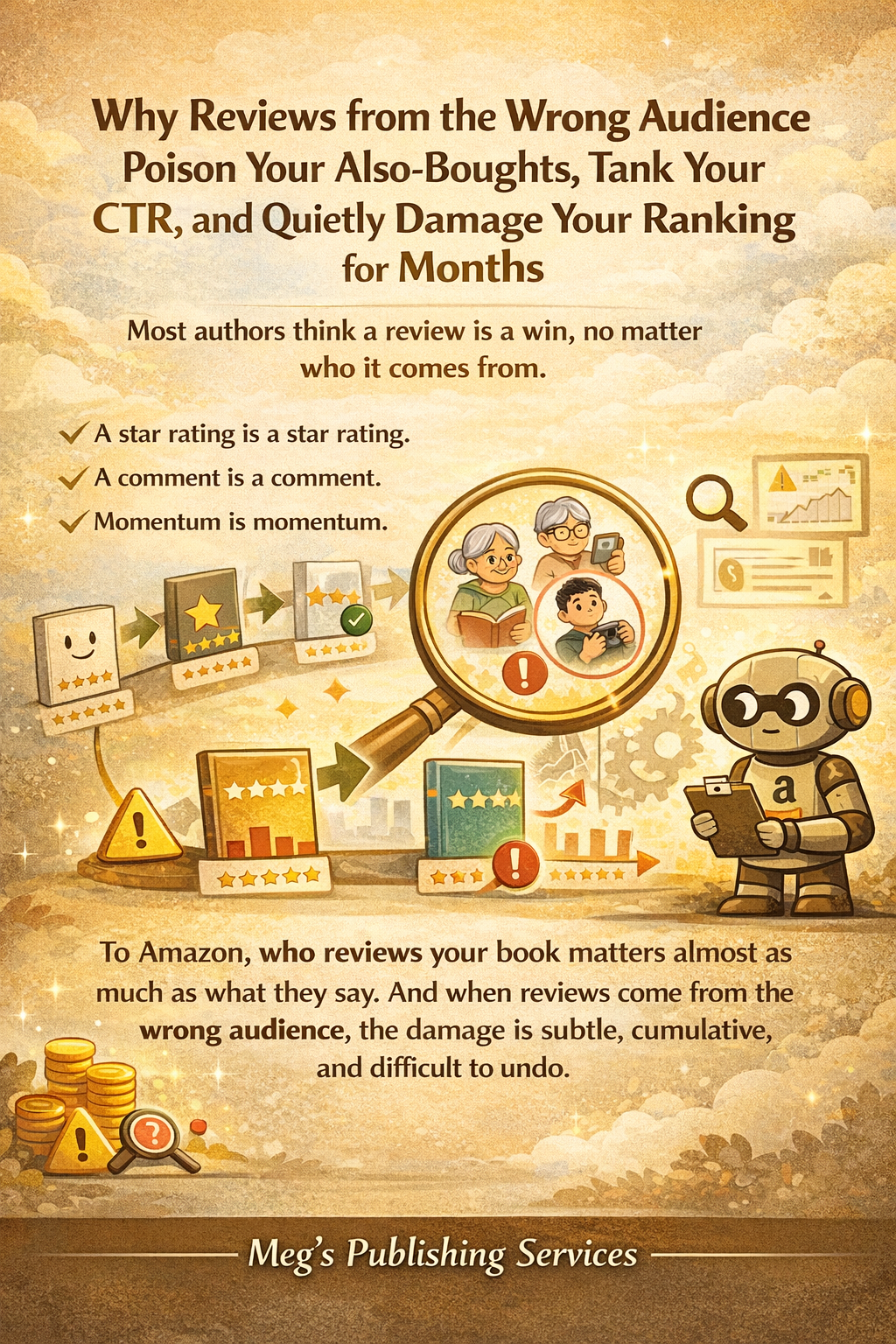
Why reviews from the wrong audience poison your Also-Boughts, tank your CTR, and quietly damage your ranking for months
Most authors think a review is a win, no matter who it comes from.
A star rating is a star rating.
A comment is a comment.
Momentum is momentum.
Amazon does not see it that way.
To Amazon, who reviews your book matters almost as much as what they say. And when reviews come from the wrong audience, the damage is subtle, cumulative, and difficult to undo.
What Amazon actually learns from a review
A review is not just feedback. It is a data point.
When someone reviews your book, Amazon doesn’t only record their opinion. It connects that review to everything else the reviewer does on the platform.
What they buy.
What they browse.
What genres they engage with.
What kinds of books they finish and respond to.
That information feeds directly into how Amazon categorizes your book, who it associates it with, and where it decides to surface it next.
This is where the problem begins.
How the wrong reviewers distort your book’s identity
Imagine a nonfiction business book reviewed mostly by friends who primarily buy romance, devotionals, or children’s books.
The reviews may be positive.
The intentions may be kind.
But the data is misaligned.
Amazon starts pairing your book with titles those reviewers also buy. Your Also-Boughts shift. Your recommendation neighbors change. Your book begins appearing in front of readers who were never your target audience.
Those readers scroll past.
CTR drops.
Engagement weakens.
Amazon adjusts exposure downward.
The system doesn’t know the reviews were “supportive.”
It only sees that the book is underperforming with the readers it’s being shown to.
Why this hurts more than no reviews at all
A book with few reviews is an unknown.
A book with misaligned reviews is misclassified.
Misclassification is harder to fix.
When Amazon’s recommendation engine builds the wrong behavioral profile around your book, every new impression reinforces the error. The book keeps getting shown to the wrong readers, who keep ignoring it, which teaches Amazon to show it less often overall.
This is how visibility quietly erodes even when the book itself is solid.
The long tail damage authors don’t expect
The effects don’t disappear after launch.
Wrong-audience reviews can influence:
Your Also-Bought network for months
Which categories your book is tested in
The types of ads Amazon shows your book alongside
The reader expectations shaping future CTR
By the time authors notice something is “off,” the book has already been trained into the wrong ecosystem.
This is why recovery often feels slow and frustrating.
Why well-meaning launch teams cause this problem
Most wrong-reviewer issues don’t come from manipulation. They come from enthusiasm.
Friends.
Family.
General mailing lists.
Broad social media asks.
People who love the author but are not the reader.
Their support feels helpful in the moment. But Amazon does not reward kindness. It rewards alignment.
What Amazon actually wants to see
Amazon looks for coherence.
Readers who buy similar books.
Reviewers whose behavior matches the category.
Engagement patterns that reinforce relevance.
When reviews come from the right audience, Amazon learns quickly who the book belongs to. Recommendations sharpen. Visibility improves.
When reviews come from everywhere, Amazon struggles to place the book confidently.
And uncertainty always leads to caution.
The uncomfortable truth
Not every review helps.
Some reviews teach Amazon the wrong lesson.
Some push your book into the wrong rooms.
Some cost you far more visibility than they give in social proof.
This doesn’t mean authors should fear reviews. It means they should respect what reviews do.
The takeaway that matters
Reviews are not just opinions.
They are behavioral signals.
Who leaves them matters.
What Amazon learns from them matters.
And alignment matters more than volume.
On Amazon, the wrong audience doesn’t just fail to buy your book.
It teaches the algorithm to stop recommending it.