

Pen Names, Legal Names, Privacy & When Pseudonyms Become Complicated
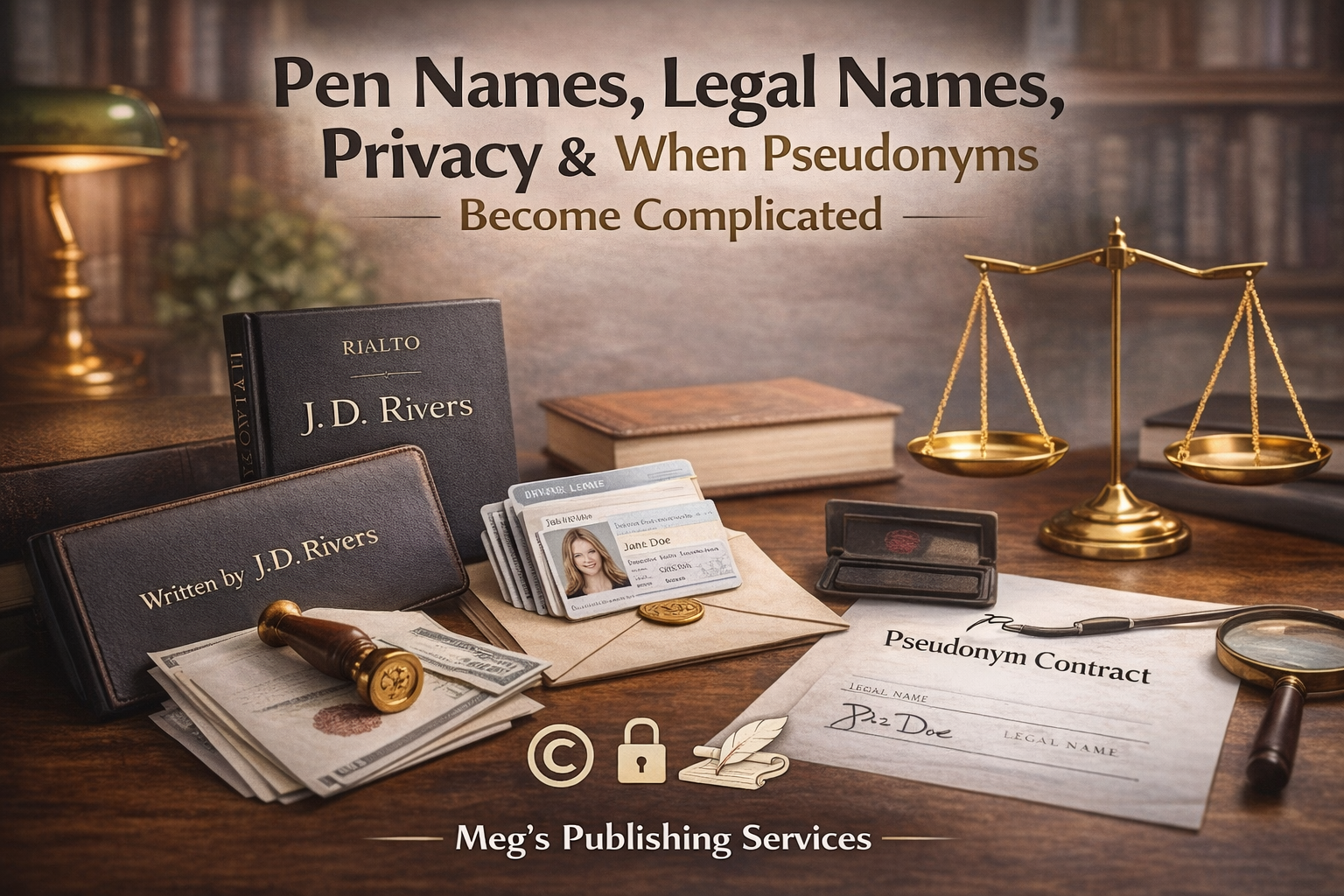
Using a pen name often starts as a simple decision.
You want privacy.
You want separation.
You want freedom to explore a genre without confusing your existing audience.
So you pick a name, upload the book, and move on.
Until something official happens.
A contract.
A payout issue.
A tax form.
An account verification request.
That’s when many authors realize a pen name is not just a creative choice. It’s a legal and operational structure—and if it isn’t set up correctly, it can create friction, delays, or outright risk.
Let’s walk through this carefully, without drama, but without skipping the parts that matter.
How copyright works when you publish under a pen name
Here’s the first truth most authors need to hear:
A pen name does not replace your legal identity. It sits on top of it.
You can publish under a pseudonym and still fully own the copyright to your work. The key distinction is who is listed as the copyright holder and how that ownership is documented.
In many jurisdictions, copyright can be registered:
In your legal name
In your pen name
Or in the name of a legal entity you control
What matters is that there is a clear, traceable connection between the work and a real, legally identifiable owner. If that chain breaks, enforcement becomes difficult. Disputes become messy. Proof becomes harder.
Pen names offer anonymity to the public — not invisibility to the law.
Signing contracts under a pseudonym (what actually works)
This is where confusion gets expensive.
You generally cannot sign binding contracts using only a pen name. Contracts require a legally identifiable party. That doesn’t mean your pen name can’t appear — it means it must be anchored to your legal identity.
Professional contracts typically handle this by stating something like:
“Jane Doe, writing under the pen name J.D. Rivers…”
That single line protects everyone involved.
The pseudonym remains intact publicly.
The legal responsibility remains clear privately.
Any agreement that asks you to sign only as a pen name, without referencing your legal name or entity, is not protecting you. It’s creating ambiguity — and ambiguity always benefits the stronger party.
When Amazon asks for your legal name (and why)
This part surprises authors who thought pen names meant full separation.
Amazon KDP allows pen names for public-facing author profiles. Readers see the name you choose. That part is straightforward.
Behind the scenes is different.
Amazon may require your legal name for:
Tax verification
Payment processing
Identity confirmation
Account disputes or audits
This is not optional. And it does not violate your pen name. It’s compliance.
Problems arise when authors:
Enter inconsistent information
Use different legal names across platforms
Attempt to fully mask identity in required fields
That’s when accounts get paused, payments get delayed, or clarification requests show up at the worst possible time.
Privacy does not mean non-compliance.
Privacy and sensitive genres: when pen names are necessary, not optional
For some authors, pen names aren’t branding tools — they’re protection.
Sensitive nonfiction, personal memoirs, trauma recovery, religious deconstruction, erotica, controversial fiction, or politically charged topics all carry real-world consequences. In these cases, separation between public work and private life is wise.
But protection requires structure.
That includes:
Separate author branding assets
Controlled social media presence
Careful metadata consistency
Clear internal documentation tying the pen name to you
The goal isn’t secrecy for its own sake. The goal is intentional distance, managed professionally.
Managing multiple pen names without breaking your business
This is where things quietly spiral for prolific authors.
Multiple pen names can work beautifully — if they’re planned. They allow genre clarity, reader trust, and targeted marketing.
They become a mess when authors:
Forget which name owns which asset
Mix mailing lists or ad accounts accidentally
Lose track of contracts tied to specific names
Can’t prove ownership during disputes
At scale, pen names are no longer “names.” They are brands.
Brands need records.
Brands need boundaries.
Brands need oversight.
This is why experienced authors eventually move pen names under a single legal entity or structured system. Not because it’s fancy — because it’s sustainable.
When pseudonyms stop being simple
Pen names stop being “fun” the moment:
Money increases
Rights become valuable
Partnerships appear
Visibility grows
That’s not a problem. That’s progress.
The authors who struggle aren’t the ones using pen names. They’re the ones who didn’t plan for what success would require.
The real takeaway
Pen names don’t remove responsibility.
They reorganize it.
Used well, they protect privacy, clarify branding, and expand creative freedom. Used casually, they introduce risk that only shows up when it’s expensive to fix.
Every fiction and nonfiction author doesn’t need fear here.
They need structure, clarity, and foresight.
That’s how pen names remain tools — not traps.