

Review Quality vs Review Quantity
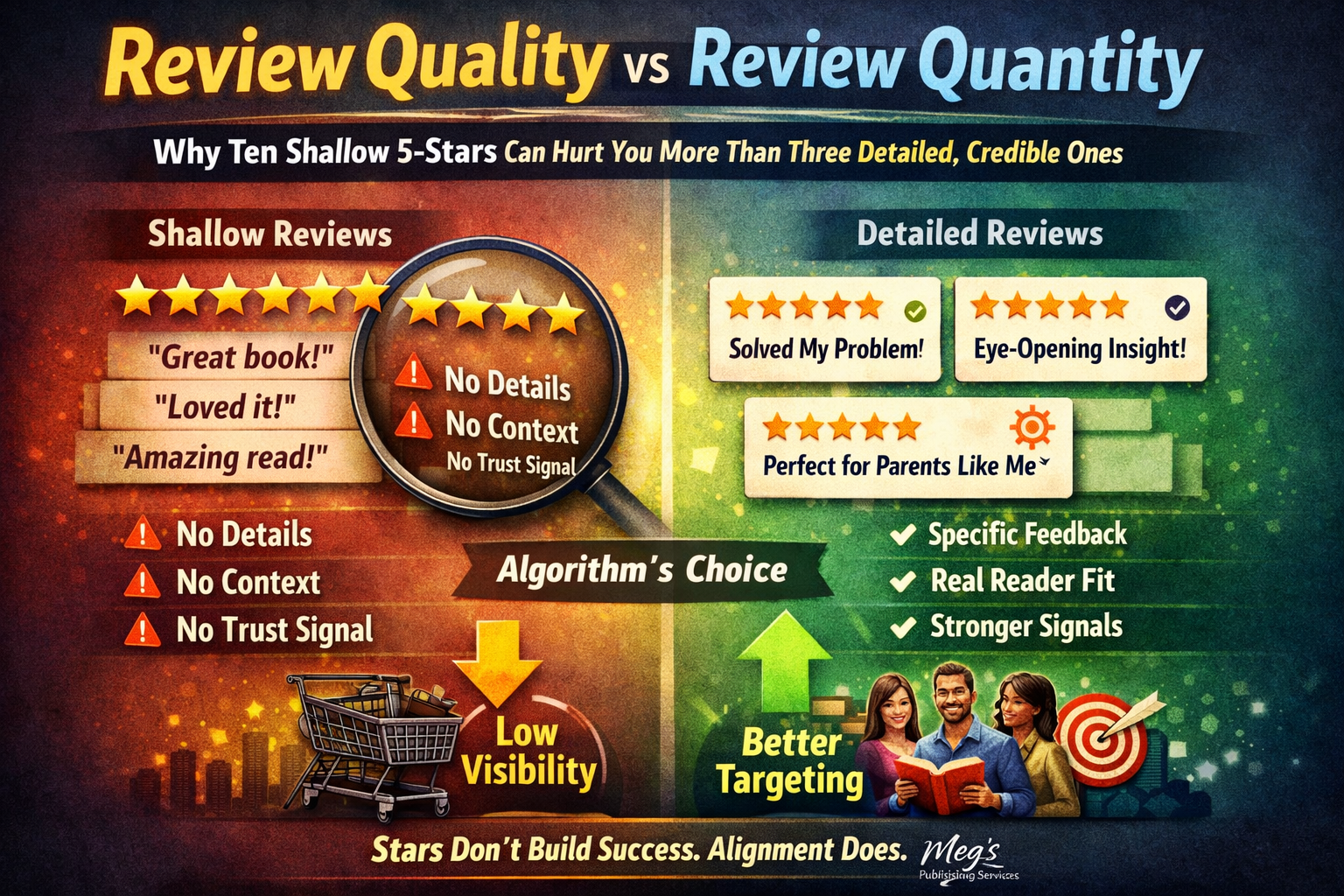
Why ten shallow 5-stars can hurt you more than three detailed, credible ones
Reviews aren’t just social proof. They’re training data. Every review teaches the marketplace how to treat your book next. When that lesson is wrong, the consequences are quiet but brutal: weaker recommendations, colder traffic, and a book that never quite gets its momentum back.
This is where many launches accidentally sabotage themselves—by chasing volume instead of credibility.
The uncomfortable truth about “more reviews”
Most authors believe reviews work like votes. More stars = more trust. That’s not how modern marketplaces work.
Platforms like Amazon don’t read reviews emotionally. They read them behaviorally.
Ten short reviews that all say:
“Great book!”
“Loved it!”
“Amazing read!”
…look persuasive to authors. But to an algorithm, they look thin, repetitive, and low-information.
And low information reviews create uncertainty.
What shallow reviews signal behind the scenes
When reviews lack detail, a few subtle signals kick in:
Low diagnostic value: The system can’t tell who the book is really for.
Weak relevance mapping: It struggles to match your book to the right readers.
Trust dilution: Repetitive phrasing can resemble coordinated or incentive-driven activity.
None of this triggers a penalty alert. There’s no warning email.
The book simply stops being pushed.
Why fewer, deeper reviews outperform high volume
Now compare that with three reviews that mention:
A specific problem the book helped solve
A chapter, concept, or shift in thinking
Who the book is best suited for
Those reviews do three powerful things at once:
They validate real reader alignment
They clarify positioning (for humans and machines)
They strengthen recommendation accuracy
To the system, those reviews aren’t just opinions.
They’re context.
And context is everything.
The launch mistake that causes long-term damage
Here’s where authors slip:
They push for reviews from anyone willing—friends, family, casual supporters—without regard for reader fit.
The result?
Reviews come fast
Stars look great
But the wrong audience gets attached to the book’s data profile
Once that happens, recovery is slow and difficult. The book keeps getting shown to people who won’t click, won’t read deeply, and won’t convert.
That’s how visibility dies without drama.
What to prioritize instead (without micromanaging the process)
This isn’t about controlling what reviewers say. It’s about who they are and why they’re reading.
High-quality reviews tend to come from readers who:
Found the book because it matched a real need
Read past the opening chapters
Can articulate why the book mattered to them
Your job is not to manufacture praise.
It’s to protect alignment.
The quiet takeaway
A small set of thoughtful, specific reviews tells the system:
“This book solves a clear problem for a defined reader.”
A large set of vague praise tells it:
“This book is liked… but by whom, and for what, is unclear.”
In a recommendation-driven marketplace, clarity always wins.
If you’re choosing between more reviews and better reviews, don’t hesitate.
Your book’s long-term visibility depends on that decision more than almost anything else.