

The Launch Stall Spiral
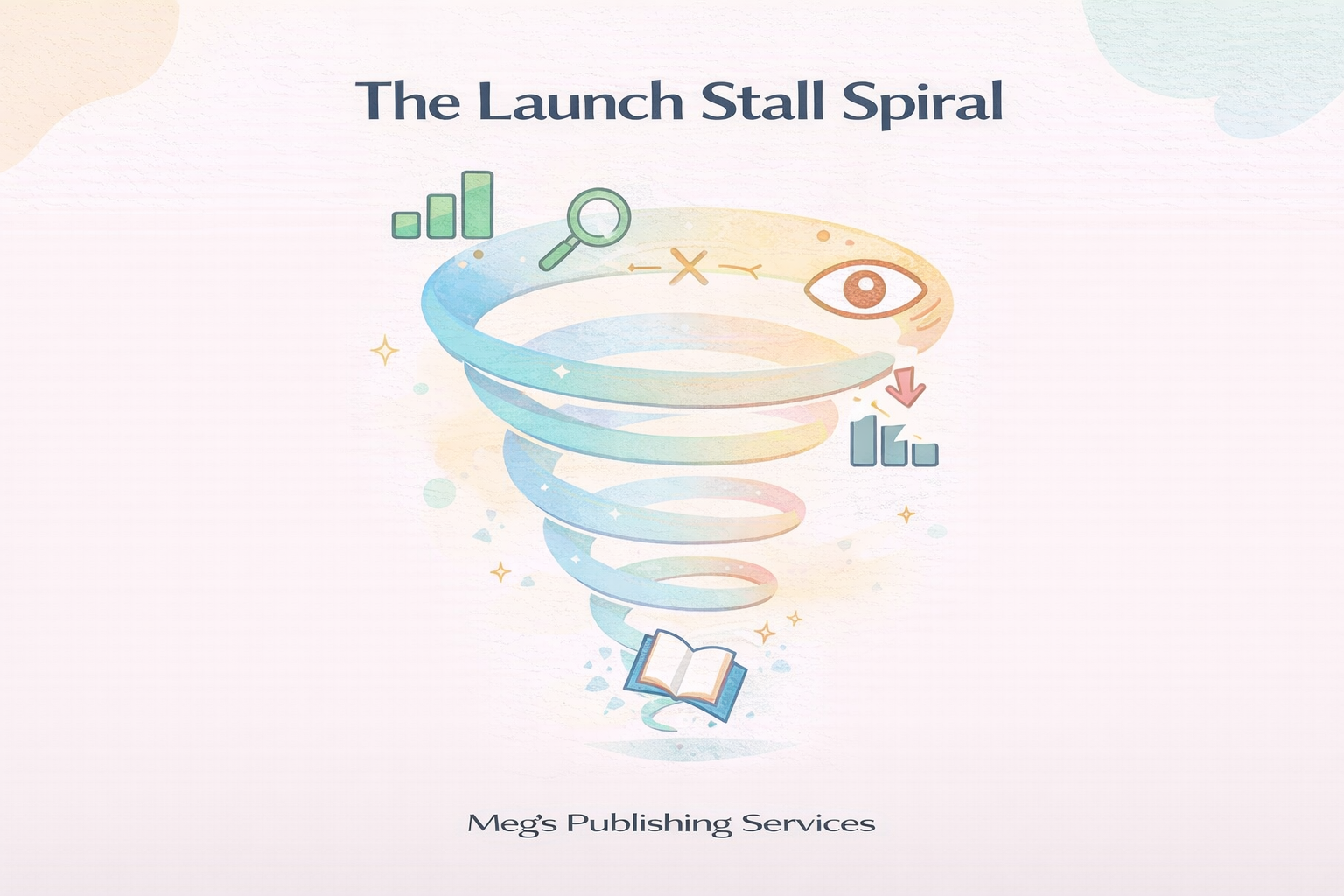
Once your book stalls, Amazon stops testing it with fresh traffic — why most authors never recover
A stalled launch doesn’t just mean slow sales. It means the marketplace quietly loses curiosity about your book.
Discovery platforms don’t keep guessing forever. They test. They observe. Then they decide whether something deserves continued exposure. When your book stalls early, that decision gets made faster than most authors realize—and it’s rarely revisited.
This is why so many books don’t “fail loudly.”
They simply fade.
What a “stall” really looks like
A stall isn’t zero sales. That’s the trap.
It looks like:
A few early sales… then silence
Ads running, but impressions drying up
Decent reviews, yet no new readers arriving
Rankings that hover, then slide
At this point, authors usually assume they need more marketing.
The real issue is lost testing privilege.
How Amazon actually treats a new book
When a book launches, Amazon runs a quiet experiment.
It tests your book with:
Different reader segments
Different recommendation slots
Different visibility surfaces
It’s watching one thing above all else:
Does this book consistently convert interest into engagement?
Clicks. Reads. Follow-through. Reviews. Return behavior.
When those signals flatten, the test ends.
The spiral most authors don’t see
Here’s where the damage compounds:
Momentum slows
Amazon reduces exposure to new readers
Fewer new readers means fewer fresh signals
The system interprets this as low relevance
Testing narrows even further
That’s the spiral.
By the time authors notice, they’re already selling only to people who were going to find the book anyway.
Why throwing ads at a stalled book rarely works
Ads don’t reset trust. They amplify what already exists.
If the book’s conversion signals are weak or unclear:
Clicks get expensive
Bounce rate rises
Read-through disappoints
From the system’s perspective, this confirms the earlier decision:
“We tested this. It didn’t stick.”
So the stall deepens.
The uncomfortable reason most authors never recover
Recovery requires relevance correction, not visibility tricks.
That usually means confronting one (or more) of these:
The book is attracting the wrong readers
The promise doesn’t match the content
Early reviews trained the algorithm incorrectly
The positioning is too vague to recommend confidently
Most authors don’t revisit these fundamentals.
They just keep promoting.
Promotion without correction accelerates the decline.
What actually changes the trajectory (high-level)
Breaking a stall isn’t about “relaunching louder.” It’s about giving the system a new reason to test again.
That only happens when:
Reader alignment becomes clearer
Engagement improves, not just impressions
The book starts performing better per exposure, not per dollar spent
Amazon doesn’t reward effort.
It rewards signal quality.
The takeaway
A stalled launch isn’t neutral. It’s a verdict in progress.
Once testing stops, recovery becomes exponentially harder—not impossible, but no longer accidental.
This is why the first weeks matter so much.
Not for hype.
For trust.
If your book stalls, the question isn’t “How do I sell more?”
It’s “Why did the system stop believing this book was worth testing?”
That answer determines whether the spiral continues—or finally breaks.