

Recovery Mode: Reversing a Bad Launch
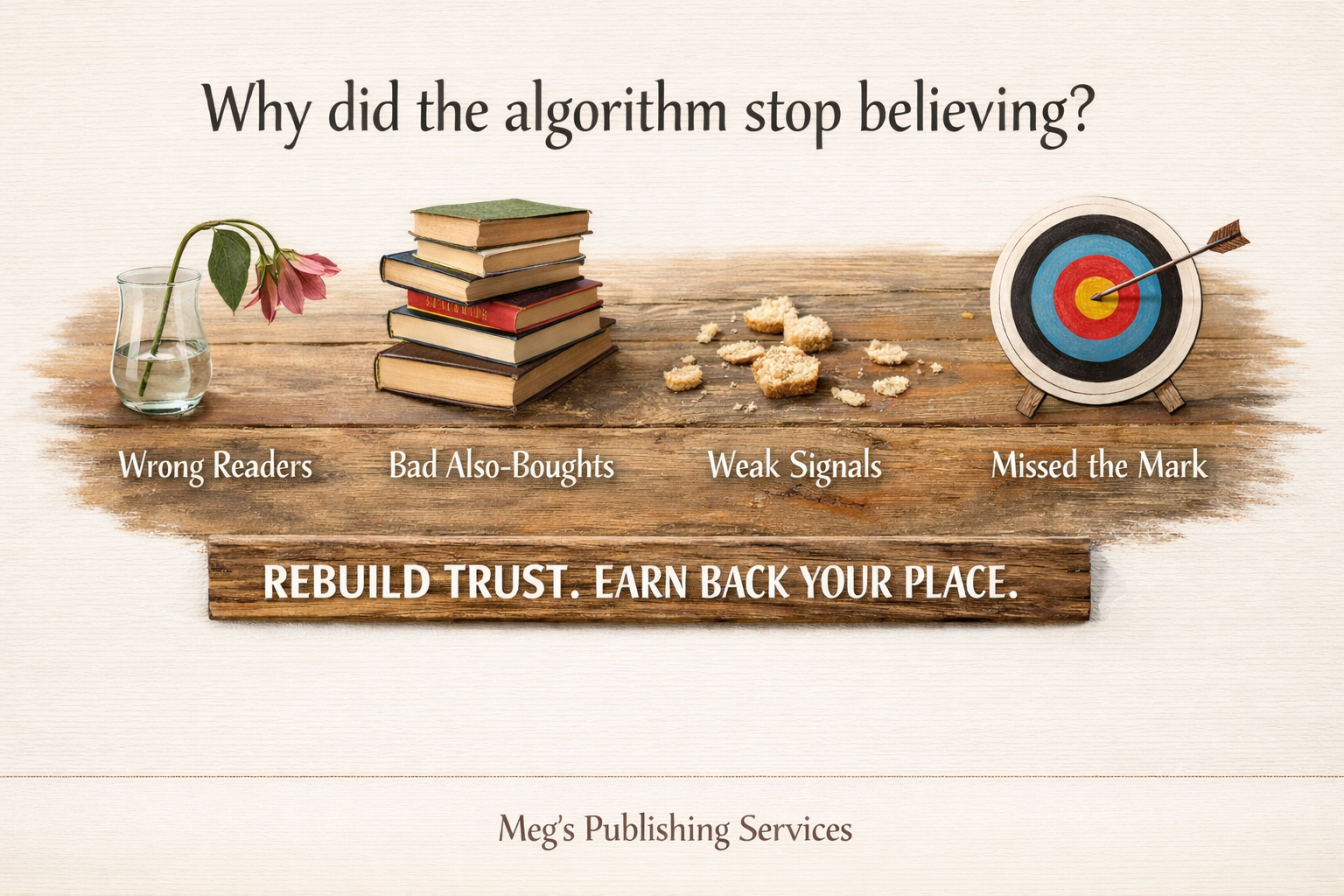
The real work required to rebuild trust, repair Also-Boughts, and pull a suppressed book back into visibility
A bad launch doesn’t just slow sales. It changes how the system understands your book.
Once trust drops, visibility doesn’t pause—it gets reassigned to other books. And the longer a title sits in that suppressed state, the harder it becomes to convince the system it deserves another look.
This is why “I’ll fix it later” is one of the most expensive decisions an author can make.
Recovery is possible.
But it’s never quick, and it’s never cosmetic.
What “suppression” actually means
Suppression isn’t a penalty notice. It’s quieter than that.
It looks like:
Ads still running, but impressions shrinking
Your book no longer appearing in relevant Also-Boughts
Traffic coming mainly from direct links or brand searches
New reviews having little to no impact
From the system’s perspective, your book has already been classified.
And classification is sticky.
Why most recovery attempts fail
Most authors respond to a bad launch by doing more of what failed the first time.
They:
Increase ad spend
Push harder for reviews
Promote aggressively on social media
Discount the book repeatedly
None of these address the real problem.
The system doesn’t need activity.
It needs better signals.
Without signal correction, every push simply reinforces the existing verdict:
“We tested this. It didn’t perform well enough.”
The hardest truth about recovery
You cannot promote your way out of a trust problem.
Recovery requires accepting that something foundational is misaligned:
The wrong readers were trained into your data
The promise didn’t match the experience
Early engagement metrics were weak or inconsistent
The book was positioned too broadly to recommend confidently
Until that mismatch is addressed, visibility won’t return in a meaningful way.
Repairing Also-Boughts starts with reader alignment
Also-Boughts are not random. They’re behavioral.
They form when readers:
View your book and another
Buy your book and another
Engage deeply across similar titles
If your early buyers were:
Friends
Casual supporters
Readers outside your true niche
…your Also-Boughts are likely polluted.
Repairing them doesn’t start with targeting ads.
It starts with changing who the book attracts next.
What real recovery work looks like (high-level)
Recovery mode is not a relaunch. It’s a retraining phase.
That means:
Tightening positioning so the system knows exactly who the book is for
Improving conversion quality, not just traffic volume
Allowing time for cleaner reader behavior to accumulate
Re-earning testing privileges through consistency, not spikes
This is slow, deliberate work.
There are no viral shortcuts.
Why patience is not optional here
Recovery happens when the system detects pattern change, not one-off wins.
That requires:
Stable engagement
Predictable reader behavior
Fewer mixed signals
Authors who expect instant rebound usually give up right before the system would have reconsidered.
Ironically, impatience is what locks many books into permanent obscurity.
The takeaway
A bad launch doesn’t end a book’s life.
But it raises the bar for everything that follows.
Recovery is possible—but only for authors willing to:
Re-evaluate fundamentals
Stop chasing surface metrics
Let signal quality lead the strategy
Visibility isn’t restored by noise.
It’s restored by trust.
And trust, once broken, has to be rebuilt—one clean signal at a time.