

The Subtitle as a Positioning Weapon
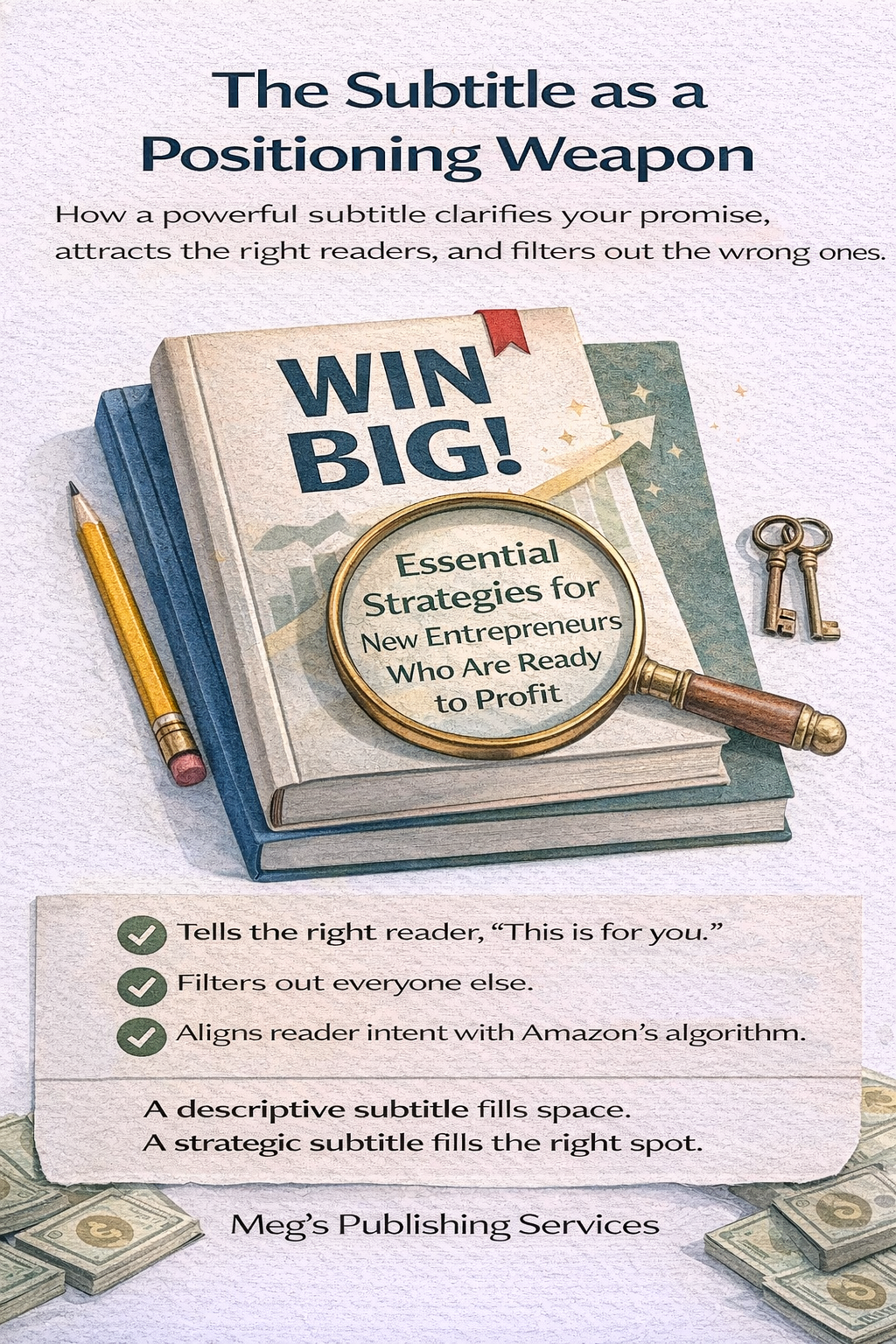
How a powerful subtitle clarifies your promise, attracts the right readers, and filters out the wrong ones
Most authors treat the subtitle like an afterthought. Something to fill space under the main title. Something descriptive. Something “nice.”
Amazon does not.
To Amazon, your subtitle is a signal amplifier. It tells the algorithm who this book is for, what problem it solves, and which readers should be shown the listing. To readers, it answers one silent question in seconds: Is this for me, or not?
That’s where most books lose.
The moment readers decide
When a reader lands on your book page, they are not in exploration mode. They are in elimination mode. They are scanning fast, cutting ruthlessly, and looking for reasons to move on.
Your title grabs attention.
Your subtitle explains why they should care.
If the subtitle is vague, clever, or ego-driven, the reader hesitates. Hesitation kills clicks. And when clicks die, Amazon quietly stops pushing the book.
Why “descriptive” subtitles fail
Many subtitles explain the content of the book instead of the outcome. They tell the reader what’s inside rather than what changes after reading.
For example:
“Thoughts, Lessons, and Reflections on Life”
That tells the reader almost nothing. There’s no promise. No positioning. No urgency. It could be for anyone, which means it’s effectively for no one.
Amazon doesn’t reward ambiguity. Readers don’t either.
What strong subtitles actually do
A strong subtitle does three things at once.
First, it names the problem or desire clearly.
Second, it hints at the outcome or transformation.
Third, it quietly filters the audience.
Filtering is not a flaw. It’s a feature.
When the wrong reader skips your book because the subtitle doesn’t speak to them, that protects your conversion rate. When the right reader clicks because they feel seen, Amazon takes note.
The hidden authority signal
Subtitles also signal credibility. A focused, specific subtitle feels confident. It sounds like the author knows exactly who they’re speaking to.
Compare:
“A Guide to Better Writing”
versus
“A Practical System for Writing Clear, Compelling Nonfiction That Sells”
One feels generic. The other feels intentional. Authority is not shouted. It’s implied through clarity.
Why subtitles influence ranking more than authors realize
Amazon tracks behavior. When readers who search certain phrases consistently click your book and stay on the page, Amazon learns who your book belongs to.
Your subtitle helps align:
• Search intent
• Reader expectation
• On-page behavior
When those line up, visibility compounds.
When they don’t, Amazon slowly drifts your book into weaker territory where it becomes harder to recover.
The real shift authors need to make
Stop asking, “Does my subtitle sound good?”
Start asking, “Does my subtitle make a clear promise to a specific reader?”
A subtitle is not decoration.
It’s positioning.
It’s pre-qualification.
It’s a quiet contract between you, the reader, and the algorithm.
Get it right, and your book attracts with less effort.
Get it wrong, and no amount of marketing will fully fix the leak.