

Your Description Is a Sales Page, Not a Synopsis
Why “explaining the book” kills conversions and how to switch to pure benefit-driven copy
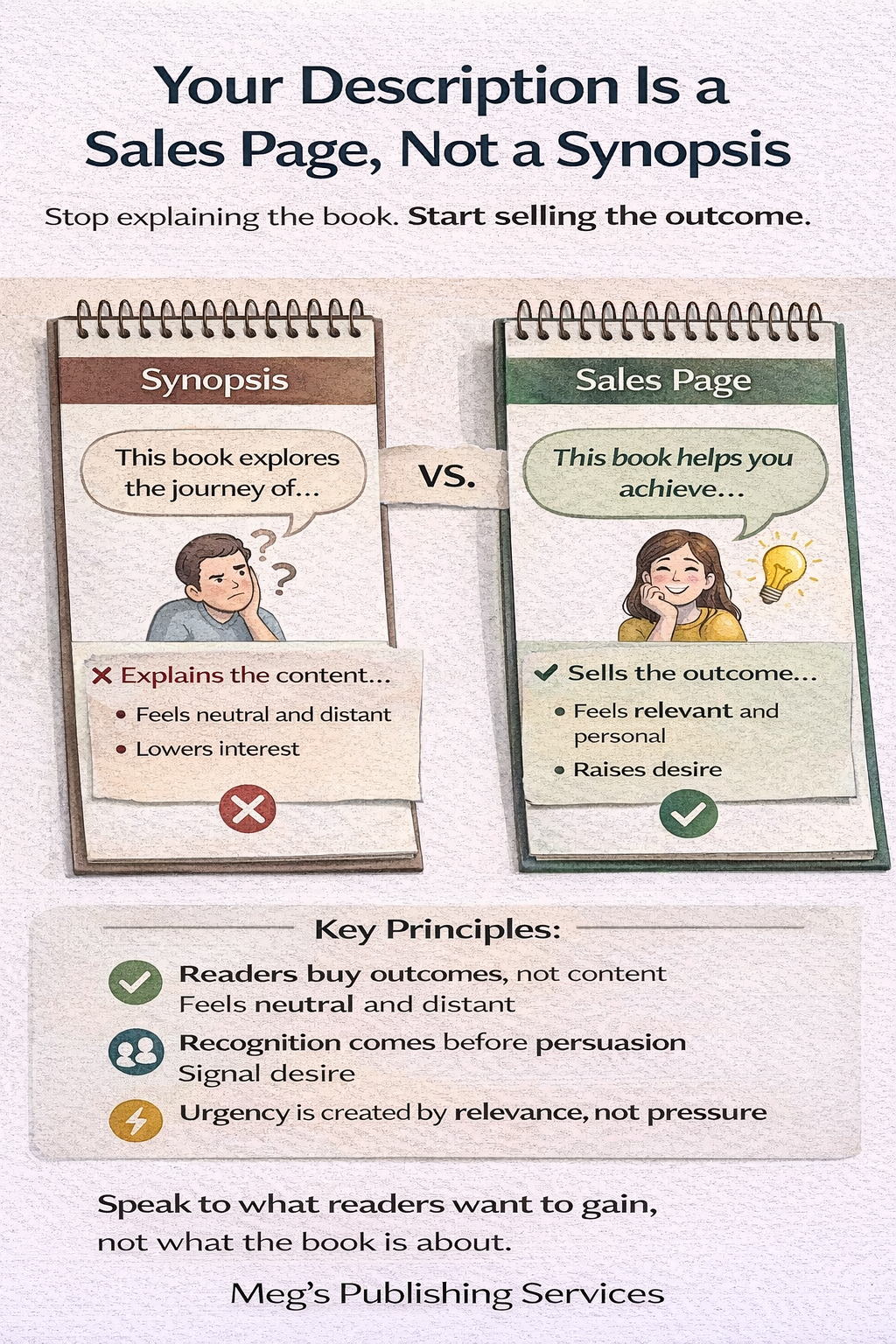
Most authors write their Amazon book description the same way they talk about their book to friends.
They explain what it’s about.
They summarize the journey.
They outline the structure.
They describe the themes.
And then they wonder why readers click the cover… and don’t buy.
The problem isn’t the writing.
It’s the purpose.
An Amazon description is not there to explain your book. It is there to sell the click into a purchase.
Those are two very different jobs.
Why explanations feel natural to authors but useless to readers
Authors know their book intimately. They’ve lived inside it for months or years. When they write the description, their instinct is to help the reader understand the work.
So they write paragraphs that sound like this:
“This book explores…”
“It follows the journey of…”
“It dives into the complexities of…”
These lines are accurate. They are also conversion poison.
Amazon readers are not trying to understand your book.
They are trying to decide whether it will do something for them.
Explanation answers curiosity.
Sales copy answers self-interest.
And self-interest always wins.
What the reader’s brain is actually asking
When a reader opens your description, they are not settling in to read. They are scanning.
Their brain is asking three fast questions:
What problem does this solve for me?
How will I feel or change after reading this?
Is this worth my money and my time?
If those answers don’t appear quickly and clearly, the reader backs out.
They don’t think, “This description is poorly written.”
They think, “This doesn’t feel essential.”
They move on.
Why synopses kill momentum
A synopsis is neutral.
A sales page is directional.
When you summarize your book, you place the reader outside the experience. You talk about the content instead of placing them inside the outcome.
This creates distance.
Distance lowers urgency.
Lower urgency lowers conversions.
Even fiction suffers from this. Readers don’t buy stories because of plot structure. They buy because of emotional payoff. Tension. Escape. Catharsis. Transformation.
Nonfiction readers are even more ruthless. They want clarity on what changes after the last page.
If your description reads like a book report, it gives the reader no reason to act now.
What benefit-driven descriptions do differently
Strong Amazon descriptions flip the focus.
Instead of explaining the book, they speak directly to the reader’s desire, frustration, or aspiration. They describe the result of reading, not the structure of the content.
They make the reader feel seen before they feel informed.
This does not mean hype or exaggeration. It means relevance.
A benefit-driven description answers questions like:
• What pain does this relieve?
• What clarity does this provide?
• What outcome does this make possible?
• What struggle does this book understand deeply?
When readers recognize themselves in the first few lines, they keep reading. When they keep reading, buying becomes easier.
Why Amazon rewards benefit-driven copy
Amazon tracks behavior after the click.
If readers open your description and stay, scroll, and buy, Amazon learns that the page is doing its job. If they open it and leave quickly, Amazon learns the opposite.
Explanation-heavy descriptions tend to lose readers early. Benefit-driven descriptions hold attention longer.
Longer attention signals relevance.
Relevance earns more impressions.
More impressions create more opportunities for sales.
The description doesn’t just influence readers.
It trains the algorithm.
How to mentally switch from synopsis to sales page
The easiest way to make this shift is to change who you imagine you’re writing for.
A synopsis is written for someone who already cares.
A sales page is written for someone who is undecided.
Stop writing to prove what the book contains.
Start writing to show why it matters to them.
You can still explain later.
But benefits must come first.
Three principles to remember (simple and sticky)
1. Readers buy outcomes, not content
They don’t care how the book is structured until they care what it will give them.
2. Recognition comes before persuasion
If readers don’t feel understood, they won’t feel convinced.
3. Urgency is created by relevance, not pressure
When the benefit feels personal, the decision feels obvious.
Final thought
Your book description is not a place to be neutral, thorough, or academic.
It is the moment where a reader decides whether your book belongs in their life.
Explaining your book might satisfy your instinct as an author.
Selling the outcome satisfies the reader’s instinct as a buyer.
When your description shifts from synopsis to sales page, conversions rise not because you became pushy, but because you finally spoke the reader’s language.
On Amazon, speaking the reader’s language is what turns interest into action.