

Color Psychology & Genre Codes
The unspoken color rules that trigger trust, emotion, urgency — and why breaking them kills CTR
Most authors think color choice is a creative decision.
They ask what looks beautiful, what feels expressive, or what stands out. They choose palettes they personally like or colors that feel meaningful to the story they wrote.
That approach makes sense emotionally. It just does not work behaviorally.
On Amazon, color is not decoration. It is communication. It tells the reader what kind of experience they are about to have before they read a single word.
When that message is unclear or contradictory, readers do not pause to decode it. They scroll.
Why readers respond to color before they read anything
Human brains process color faster than text. Long before a reader consciously reads your title, their brain has already made assumptions based on the colors on your cover.
Those assumptions are not personal. They are learned.
Readers build visual expectations through repetition. Over time, they associate certain color families with certain genres, tones, and emotional outcomes. These associations become shortcuts that help them decide quickly whether a book feels safe, familiar, and worth clicking.
Amazon shoppers rely heavily on these shortcuts because they are making decisions at speed, often on a phone, often while distracted.
Color does the first round of filtering.
What genre color codes actually do
Genre color codes are not rules invented by designers. They are patterns reinforced by reader behavior.
When readers repeatedly buy and enjoy books that share similar color palettes, their brain learns to trust those signals. When they see those colors again, recognition happens instantly.
This is why certain genres consistently lean toward specific palettes.
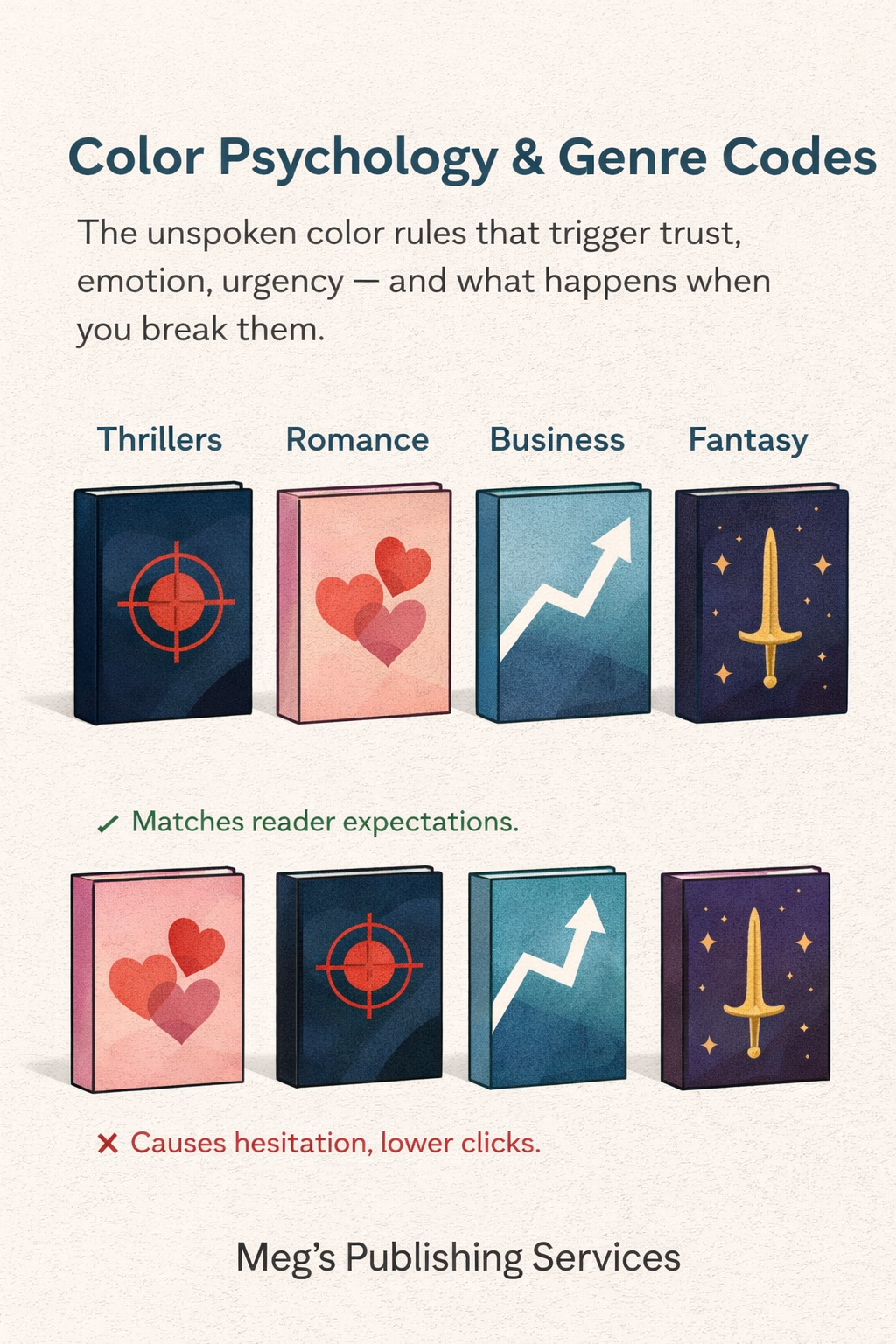
Thrillers often use dark backgrounds with high contrast accents because they signal tension and danger. Romance often leans into warmer or softer tones that suggest emotion and intimacy. Business and nonfiction frequently rely on blues, blacks, and whites because they communicate authority, clarity, and credibility.
These palettes are not mandatory, but they are meaningful.
They tell the reader, “You are in the right place.”
Why breaking color expectations hurts more than it helps
Many authors believe that breaking color conventions will help them stand out.
In reality, it often does the opposite.
When a cover uses colors that conflict with genre expectations, the reader experiences a moment of hesitation. They may not consciously identify what feels off, but their brain flags uncertainty.
Uncertainty slows decision-making.
Slower decisions reduce clicks.
A thriller with pastel tones may feel emotionally confusing. A romance with stark, corporate colors may feel cold. A business book with playful, whimsical colors may feel unserious.
The reader does not think, “This author broke genre rules.”
They think, “This does not look like what I’m looking for.”
And they move on.
How color directly affects click through rate
Click through rate is one of the earliest and strongest signals Amazon uses to evaluate relevance.
When readers see your book and click, Amazon learns that the visual presentation matched their expectations. When readers see your book and skip it, Amazon learns that something did not connect.
Color plays a significant role in that first interaction.
A cover that uses genre-aligned colors feels familiar and trustworthy at a glance. A cover that uses unexpected colors introduces friction before the reader even reads the title.
Over time, that friction shows up as lower CTR, fewer impressions, and weaker visibility.
This is why authors often feel like their book is being ignored even when the topic is strong. The issue is not the content. It is the signal.
Color does not need to be boring to be effective
Following genre color codes does not mean your cover has to look generic.
Strong covers work within expectations, not against them.
They use familiar color families but differentiate through composition, contrast, imagery, and typography. They signal genre clearly first, then layer personality on top.
This balance allows readers to recognize the book instantly while still noticing what makes it distinct.
Originality works best when it operates inside clarity, not instead of it.
Why authors struggle with this concept
Authors live with their books for a long time. They understand the nuance, the emotion, and the intention behind every choice. They want the cover to reflect that depth.
Readers do not have that context.
They are encountering your book for the first time, in a crowded marketplace, with limited attention. They are not looking for symbolism. They are looking for reassurance.
Color provides that reassurance faster than anything else.
How to think about color strategically
A useful mental shift is this: your cover color is not about expressing the story you wrote. It is about matching the emotional promise the reader expects.
Ask not what the color means to you, but what it signals to someone who has never heard of your book.
When color, genre, title, and imagery all point in the same direction, the reader feels confident. Confidence leads to clicks. Clicks lead to visibility.
Final thought
Color psychology is not manipulation. It is communication.
Amazon rewards books that communicate clearly, quickly, and consistently. When your cover colors align with genre expectations, readers understand your book faster. When they understand it faster, they are more likely to click.
Breaking color conventions does not make you bold. It often makes you invisible.
Trust is built through familiarity.
Emotion is triggered through recognition.
When you choose colors that speak the reader’s language, your book stops asking for attention and starts earning it.