

The “Shelf Test” vs the “Phone Test”
Why a cover that looks amazing on a bookshelf dies instantly on a small Amazon thumbnail
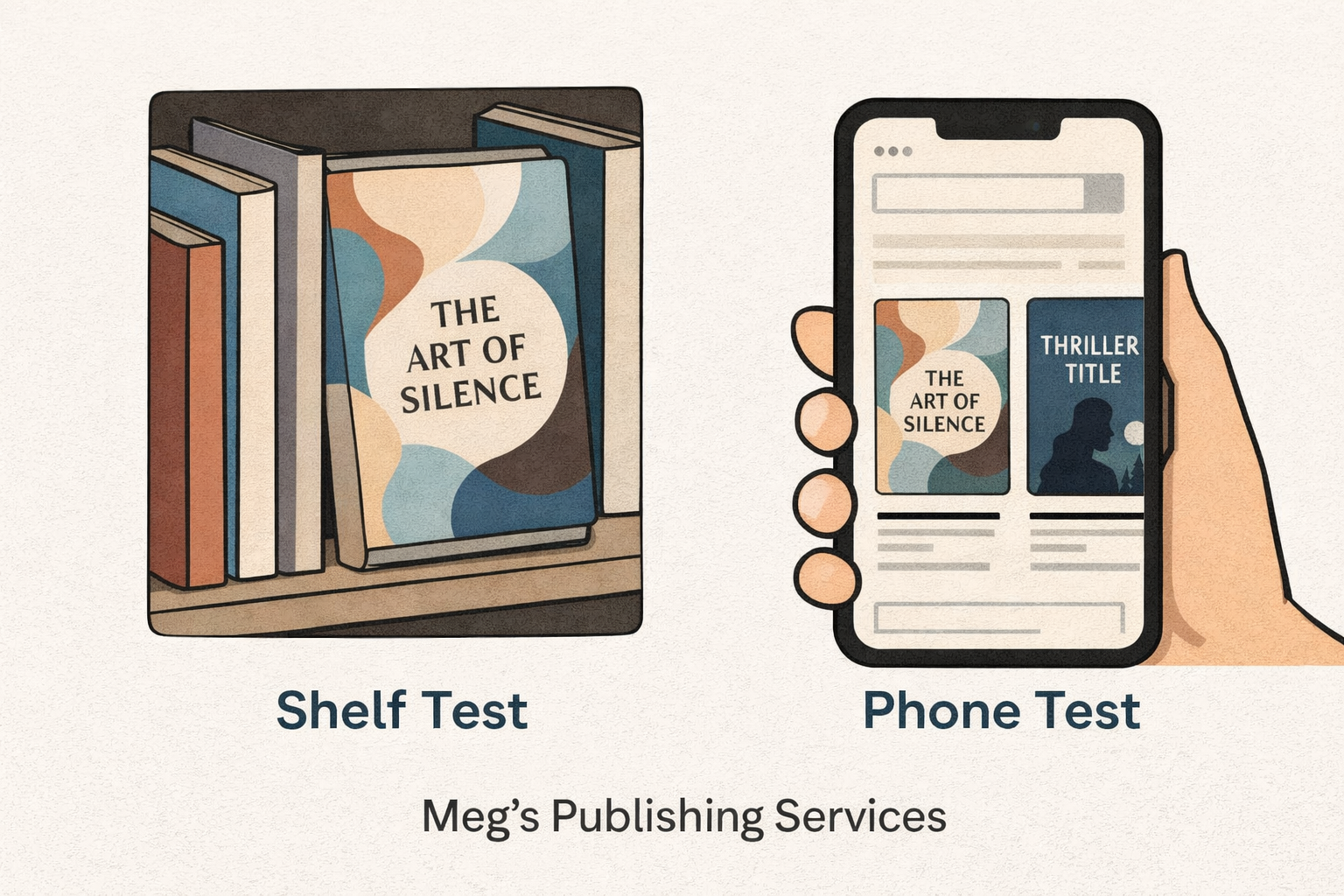
Most authors judge their book cover the wrong way.
They imagine it on a shelf. Full size. Plenty of space. Good lighting. Time to look. Time to appreciate the details, the texture, the symbolism, the thought behind every design choice.
And in that setting, many covers are genuinely beautiful.
The problem is that Amazon is not a bookshelf. It is a phone screen.
The difference between those two environments is where many good books quietly lose their chance at visibility.
The Shelf Test and why it feels so convincing
The shelf test is intuitive. You hold the book or see a mockup and ask yourself whether it looks professional, polished, and worthy of sitting beside other respected titles. You notice the typography, the imagery, the balance of the layout, and the overall mood.
If it feels right, you assume it will perform well.
That assumption makes sense because the shelf test rewards artistry, intention, and detail. It favors covers that invite lingering and reward closer inspection.
Unfortunately, that is not how Amazon shoppers encounter your book.
The Phone Test and why it decides everything
On Amazon, your cover is rarely seen at full size. It appears as a thumbnail on a phone screen, surrounded by dozens of competitors, while the reader scrolls quickly with their thumb.
In that context, the cover is not being admired. It is being scanned.
The phone test asks a very different question than the shelf test. It asks whether the cover still communicates genre, tone, and promise when reduced to a small rectangle that the reader glances at for a second or two.
Most covers that pass the shelf test fail the phone test because the elements that make them beautiful are the first things to disappear at thumbnail size.
Subtle imagery becomes noise. Delicate typography becomes unreadable. Symbolism becomes invisible. What remains is often ambiguity.
Ambiguity is deadly on Amazon.
What the reader’s brain does on a phone screen
When readers scroll Amazon on their phone, their brain is not evaluating quality. It is performing rapid pattern recognition.
They are looking for familiar visual cues that tell them they are in the right place. Color palettes they associate with a genre. Font styles they have seen on books they enjoyed before. Layouts that feel safe because they match past purchases.
This happens almost automatically.
If the cover does not clearly signal its category and intent at a glance, the reader does not stop to investigate further. They simply move on to the next option that feels easier to understand.
This is not a flaw in readers. It is a survival mechanism in an environment with too many choices.
Why artistic covers struggle at thumbnail size
Artistic covers are often built on nuance. They assume time, attention, and curiosity. They reward the reader who leans in.
At thumbnail size, nuance collapses.
The phone test strips away everything except the most dominant shapes, colors, and words. If those remaining elements do not clearly communicate what the book is and who it is for, the cover fails its primary job.
This is why authors are often confused when a cover that receives praise from designers and other writers performs poorly in search results.
The cover did not fail creatively. It failed contextually.
What strong Amazon covers do differently
Covers that pass the phone test are designed from the outside in, not the inside out.
They prioritize legibility at small sizes, with bold typography that remains readable on a phone screen. They use imagery that communicates genre instantly rather than metaphorically. They lean into familiar visual language not because the author lacks originality, but because familiarity reduces friction.
These covers may look less impressive in isolation. On a shelf, they can even feel plain.
But on Amazon, surrounded by competitors and viewed at thumbnail size, they stand out precisely because they are easy to understand.
They do not demand attention. They earn it.
Why Amazon rewards the Phone Test, not the Shelf Test
Amazon learns from behavior. It tracks which covers get clicked and which get ignored. It does not know why a reader scrolled past your book. It only knows that they did.
Covers that pass the phone test generate higher click through rates. Higher click through rates signal relevance. Relevance earns more impressions. More impressions create more opportunities for conversion.
Covers that fail the phone test are quietly shown less over time, regardless of how beautiful they are at full size.
This is why visibility often declines without obvious explanation. The system is responding to reader behavior that authors never see.
How to think about covers going forward
A strong Amazon cover is not a compromise between art and strategy. It is a sequence.
Clarity comes first. Recognition comes second. Creativity comes third.
Once a reader understands instantly what the book is and whether it is for them, creativity has room to matter. Before that moment, it only adds friction.
The shelf test flatters the creator. The phone test serves the reader.
And on Amazon, serving the reader is what gets rewarded.
Final thought
If your cover looks amazing on a bookshelf but disappears on a phone screen, it is not doing its job.
Your cover does not exist to be admired up close. It exists to survive a fast scroll.
When you design for the phone test first, everything else starts working more easily. Readers click more often. Amazon trusts your book more quickly. Visibility becomes steadier instead of unpredictable.
The goal is not to abandon beauty. It is to make beauty readable at the size where decisions are actually made.
On Amazon, that size is a thumbnail.