

The 3-Second Rule
Readers decide in three seconds if your book is worth clicking. Here’s what their brain scans for instantly
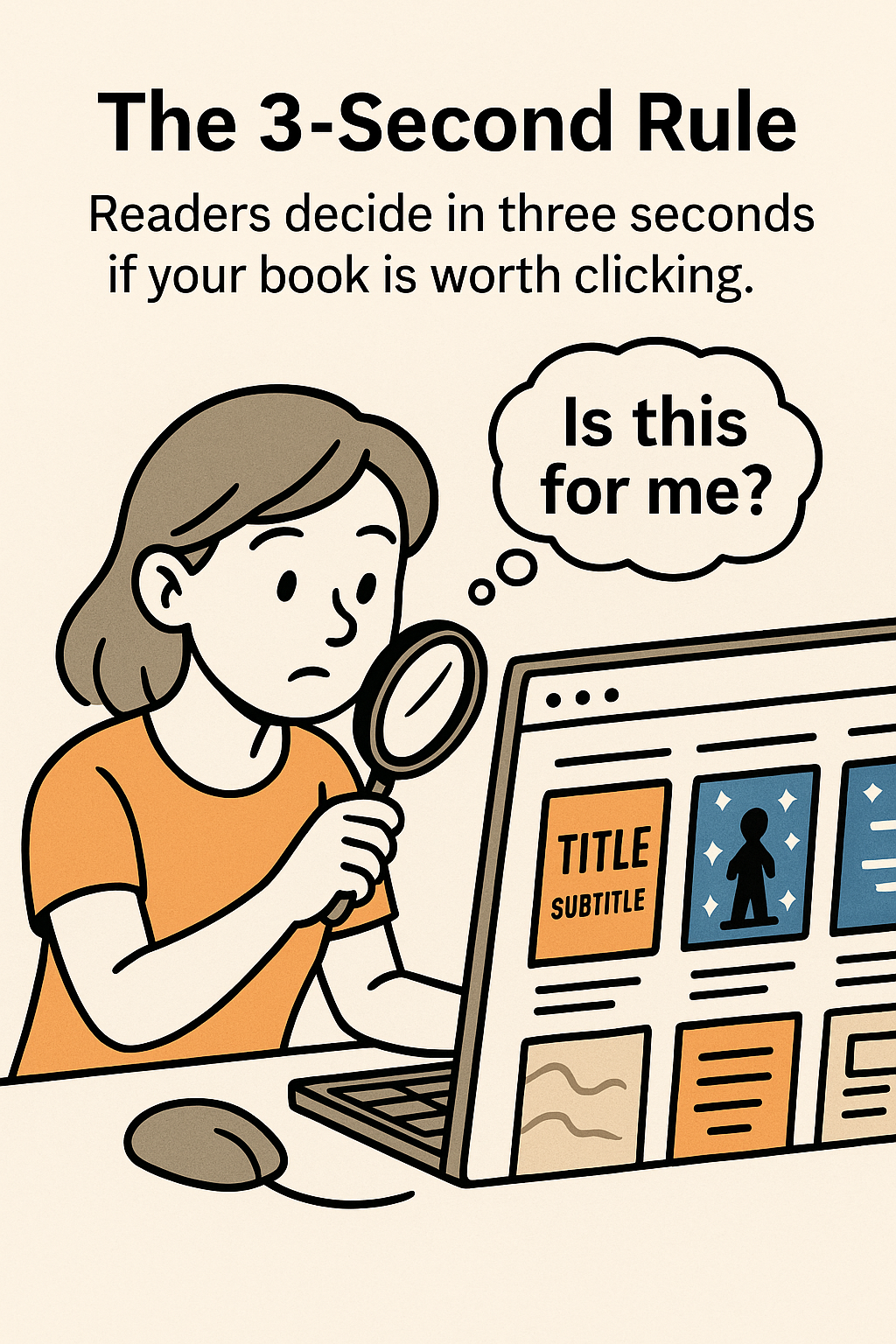
Most authors imagine readers discovering their book slowly. They picture someone lingering on the cover, reading the subtitle carefully, absorbing the description, maybe even feeling curious enough to click “Look inside.”
That is not what happens on Amazon.
What actually happens is much faster and much harsher.
A reader scrolls. Their eyes move quickly. Within roughly three seconds, their brain makes a decision.
Not a thoughtful decision. Not a fair one. A survival decision.
“Worth my time or not?”
Once that decision is made, it is almost never revisited.
This is the three-second rule, and it quietly determines whether your book gets clicked, ignored, or buried without explanation.
Why three seconds is all you get
Amazon shoppers are not browsing like people in a bookstore. They are scanning like people in a supermarket aisle with limited time and unlimited options.
Their brain is doing rapid pattern recognition, not analysis.
In those three seconds, the reader is not asking if your book is well written, researched, or meaningful. They are asking whether it looks like something that belongs to the category of books they already trust.
The human brain is wired to reduce risk, and on Amazon, unfamiliar signals feel risky. Anything that requires interpretation, decoding, or effort feels like friction.
Friction kills clicks.
Amazon does not care why a reader scrolls past your book. It only registers that they did. Enough scroll pasts, and the algorithm quietly learns that your book is not a strong match for that audience.
This is why visibility often disappears without drama or warning.
What the reader’s brain actually scans in those three seconds
Readers are not reading your book page in order. Their eyes jump.
They scan specific elements almost instinctively, and those elements either align quickly or they do not.
The first thing the brain checks is the cover’s genre signal. Does this look like the kind of book I am searching for right now, based on color, imagery, typography, and overall visual language? This happens almost subconsciously, because readers have already trained themselves through hundreds of past purchases.
Next, the brain registers the title and subtitle relationship. Not the cleverness of the words, but whether the promise makes sense immediately. A title that sounds poetic but vague creates hesitation. A subtitle that clarifies the benefit or topic reduces that hesitation.
Then the eye briefly checks relative positioning. What books are around this one? Do they feel related? Does this book look like it belongs among them, or does it feel like an outlier that wandered into the wrong space?
Only after those signals pass does the reader consider clicking to read more.
If any one of these checks fails, the reader scrolls.
They do not pause to diagnose why. They simply move on.
Why beautiful books still fail the three-second test
One of the hardest truths for authors to accept is that beauty does not equal clarity.
A cover can be elegant, artistic, and thoughtfully designed, and still fail at its job if it does not communicate genre and intent instantly. A title can be clever and emotionally resonant, and still confuse a scanning reader if it does not anchor itself to something recognizable.
This is not because readers lack taste or intelligence. It is because they are operating in a high-choice, low-attention environment.
Amazon rewards books that reduce cognitive load.
The clearer your signals are, the safer your book feels. The safer it feels, the more likely a reader is to click. The more clicks you earn from the right audience, the more confidence Amazon builds in showing your book again.
Creativity is not punished. It is simply secondary.
How the three-second rule shapes Amazon’s trust in your book
Every impression Amazon gives your book is a small test.
When readers see your book and click, Amazon learns that the match was good. When readers see your book and ignore it, Amazon learns that the match was weak.
Over time, these micro-decisions accumulate into a clear pattern.
Books that consistently pass the three-second scan get tested more often, shown more widely, and placed into stronger recommendation loops. Books that fail the scan are quietly shown less, even if the writing inside is excellent.
This is why marketing efforts often feel ineffective when the underlying signals are unclear. Traffic only amplifies what already exists. If your book fails the three-second test, more traffic simply teaches Amazon to stop trying.
What strong books do differently in those first three seconds
Books that perform well on Amazon do not rely on explanation. They rely on recognition.
They use covers that look familiar within their genre, not because the authors lack originality, but because familiarity creates instant understanding.
They pair titles with subtitles that remove ambiguity rather than adding cleverness.
They ensure that their book looks like it belongs exactly where it appears, surrounded by similar promises and expectations.
This does not mean sacrificing personality or depth. It means sequencing them correctly.
Clarity first. Personality second.
Three things to remember about the three-second rule
First, readers decide emotionally before they decide logically. Your book must feel right before it can be evaluated.
Second, Amazon learns from behavior, not intention. It does not know what you meant. It only knows what readers did.
Third, your book does not get unlimited chances. Early impressions shape long-term visibility more than most authors realize.
Final thought
The three-second rule is not unfair. It is simply honest.
Readers are telling you what they need in order to feel confident clicking. Amazon is listening closely to that behavior.
Your job is not to slow readers down. Your job is to meet them where they already are.
When your book communicates clearly in those first three seconds, everything that follows becomes easier. Clicks increase. Trust builds. Visibility stabilizes.
Not because your book changed, but because the reader understood it faster. And on Amazon, speed of understanding is everything.