

POD vs Offset Printing: When You Should Walk Away from Print-on-Demand
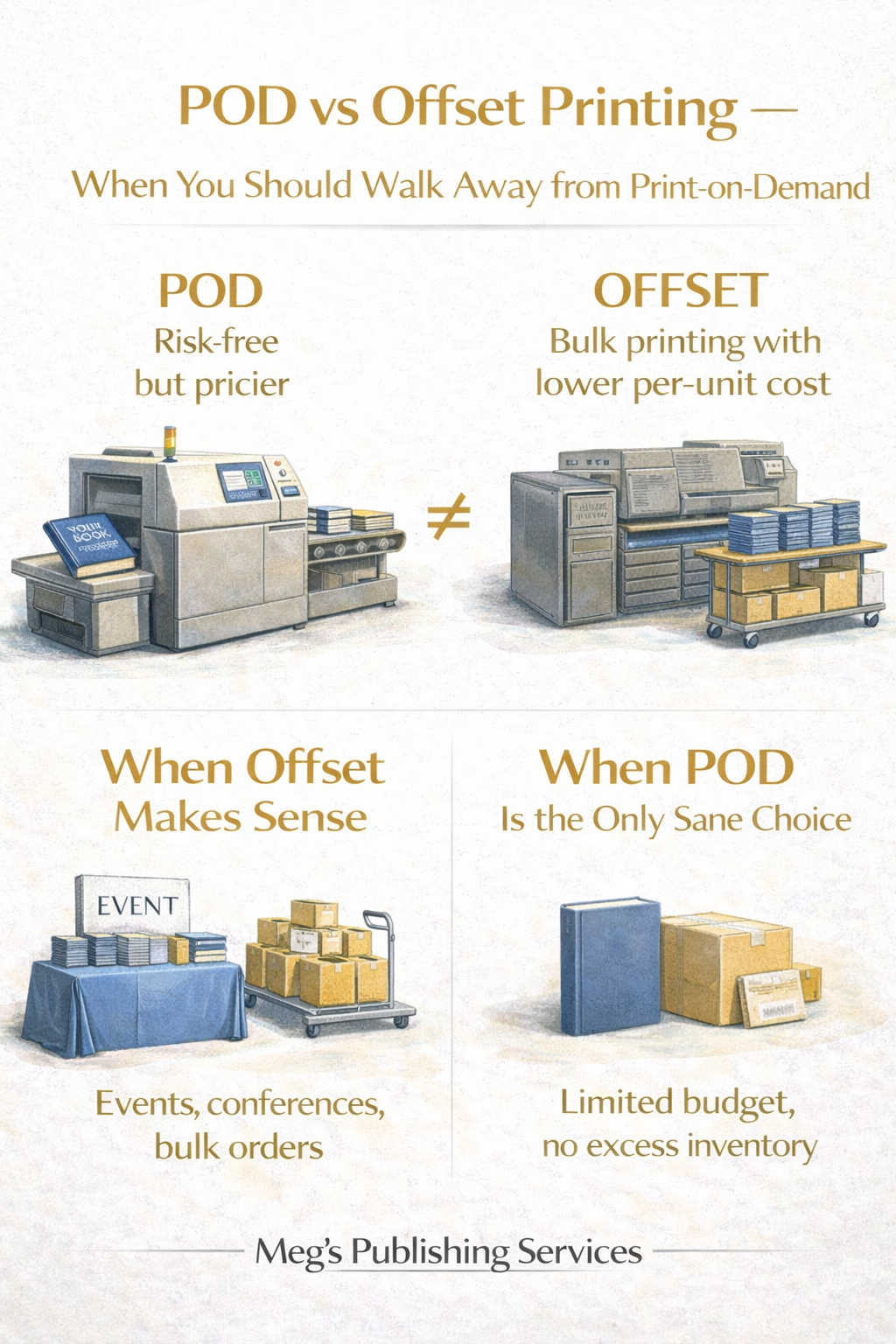
Print-on-Demand is powerful. It is also not universal.
Treating POD as the answer to every printing situation is how authors lose money, misprice books, and make decisions that do not fit their real goals.
Knowing when to use POD and when to walk away from it is what separates platform users from publishing strategists.
Offset printing and POD solve different problems
Offset printing is bulk printing.
You print hundreds or thousands of copies at once.
The more you print, the lower the per-unit cost becomes.
POD is on-demand printing.
Books are printed one at a time or in very small batches.
You avoid inventory risk, but each copy costs more.
Neither is better by default.
They answer different questions.
What POD is actually good at
POD is designed for:
Zero inventory
Unpredictable demand
Ongoing online sales
Multiple formats and revisions
Low-risk publishing
It shines when you do not want boxes of books in your house, car, or office.
If demand fluctuates, POD protects you from guessing wrong.
That protection is what you pay for.
Why POD is more expensive per copy
POD is priced for flexibility, not volume.
Each book is:
Printed individually
Routed through automated systems
Packaged and shipped separately
There are no bulk efficiencies.
Trying to force POD to behave like offset printing creates frustration.
The cost structure is not broken.
It is intentional.
When offset printing actually makes sense
Offset printing becomes the smarter choice when:
You need hundreds or thousands of copies at once
You are selling at events or conferences
You have confirmed bulk orders
You need a lower unit cost for resale margins
You want premium paper or specialty finishes at scale
In these cases, POD becomes unnecessarily expensive.
Offset is not risky when demand is already guaranteed.
When POD is the only sane choice
POD is the right option when:
You are launching a new book
Demand is uncertain
You want global availability
You plan ongoing updates or editions
You are selling primarily online
You want distribution without logistics
Most first-time authors fall into this category.
Walking into offset printing too early is how authors end up with unsold inventory and cash tied up in boxes.
The mistake authors keep making
Authors often ask:
“Which is better, POD or offset?”
That is the wrong question.
The right question is:
“What problem am I solving right now?”
If the problem is risk, POD wins.
If the problem is unit cost at scale, offset wins.
Using the wrong method for the wrong problem creates waste.
Why this decision affects strategy, not just printing
Printing decisions affect:
Pricing
Cash flow
Storage
Fulfillment
Distribution
Marketing timelines
POD and offset are not printing choices alone.
They are business structure decisions.
Strategic publishers switch methods when the situation changes. They do not stay loyal to one system out of habit.
Final thought
POD is not inferior to offset. Offset is not outdated compared to POD.
They are tools.
Knowing when to use each one is what makes a publisher strategic instead of reactive.
If you are unsure whether POD still makes sense for your current goals, or whether offset printing would serve you better, pause before committing either way.
If you want help choosing the right printing strategy for your book, your audience, and your sales plan, reach out to Meg’s Publishing Services. We help authors make decisions based on reality, not platform defaults.