

Why Ebook, Paperback, and Hardcover All Behave Differently
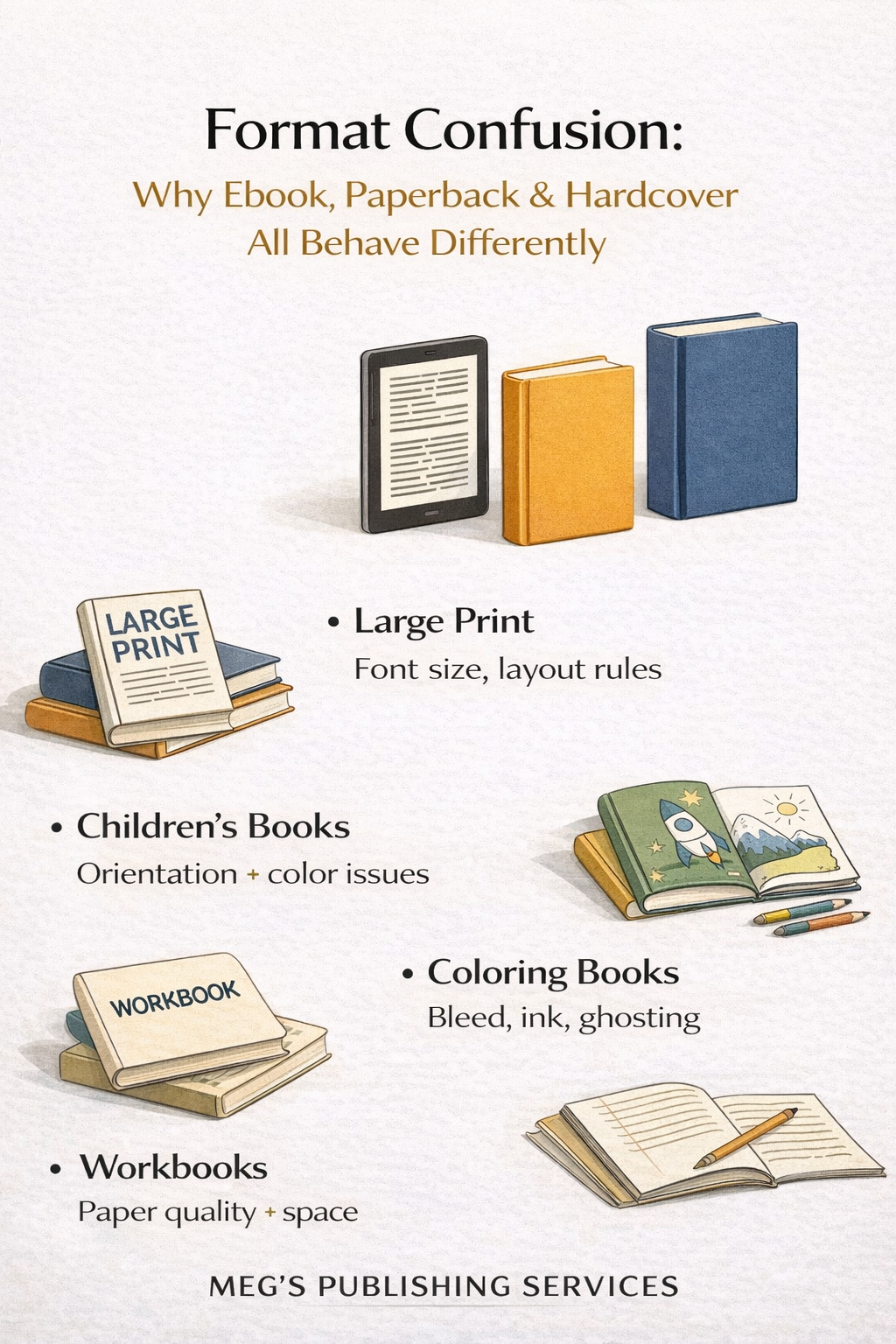
Authors often assume one book equals one layout.
That assumption causes formatting stress, upload failures, poor reader experience, and unnecessary redesign costs.
Ebook, paperback, and hardcover are not variations of the same product.
They are different systems with different rules.
Once you understand how each behaves, the confusion stops.
Page count is not universal
Page count only exists in print.
Ebooks do not have fixed pages.
They reflow based on:
Device size
Font choice
Reader settings
Screen orientation
That is why ebook “page numbers” never match print.
Trying to force identical pagination across formats is a waste of time. The systems are not designed to agree.
Print books are fixed.
Ebooks are fluid.
Why ebook layout can never match print layout
Print layout is spatial.
Margins, page breaks, widows, orphans, and alignment matter.
Ebook layout is responsive.
Text adjusts dynamically to the reader.
That means:
Page breaks disappear
Font sizes change
Line spacing shifts
Chapter starts move
A beautifully formatted print interior can look broken if reused for ebook without adaptation.
Ebooks require a separate formatting approach, not a resized print file.
Large print follows its own rules
Large print is not “make the font bigger.”
It requires:
Larger font sizes
Increased line spacing
Wider margins
Larger trim sizes
Clear, high-contrast design
Large print books serve accessibility needs.
That changes layout priorities completely.
Trying to squeeze large print into standard trim sizes creates thick, awkward books that cost more to print and feel uncomfortable to use.
Large print is a different product.
It must be built intentionally.
Children’s books are format-sensitive
Children’s books break many adult publishing assumptions.
Key differences include:
Portrait vs landscape orientation
Heavy reliance on color
Image-to-text balance
Full-bleed illustrations
POD platforms have stricter rules for color coverage and bleed.
Ignoring those rules leads to washed colors, cropped art, or rejected files.
Children’s books demand platform-aware design.
Guessing here is expensive.
Coloring books are not simple either
Coloring books create unique print challenges.
They require:
Correct bleed handling
Paper that minimizes ink bleed-through
Layouts that avoid ghosting
One-sided printing considerations
Using standard POD paper without planning often leads to:
Ink bleeding through pages
Poor user experience
Negative reviews focused on “quality”
Coloring books succeed or fail at the printing level, not the content level.
Workbooks need space, not compression
Workbooks are meant to be written in.
That changes everything.
They need:
Thicker paper
Adequate spacing
Room for handwriting
Durable binding
Thoughtful margins
Formatting a workbook like a regular nonfiction book makes it frustrating to use.
Readers feel that immediately.
Why format confusion causes most production problems
Authors try to make one file do too much.
One layout for all formats.
One interior for every use case.
The result is:
Rejected uploads
Reader complaints
Redesign costs
Endless revisions
Each format has different physics, expectations, and constraints.
Final thought
Your book does not just need to look right. It has to behave correctly in its format.
Ebook, paperback, hardcover, large print, children’s books, coloring books, and workbooks all follow different rules. Respecting those rules saves time, money, and stress.
If you are unsure whether your formats are built correctly for how readers actually use them, pause before publishing further.
If you want your book formats structured properly across systems, reach out to Meg’s Publishing Services. We help authors build each format for how it is meant to function, not how it is assumed to work.