

Formatting Psychology
How line breaks, spacing, bolding, and structure quietly increase reading retention and click-through
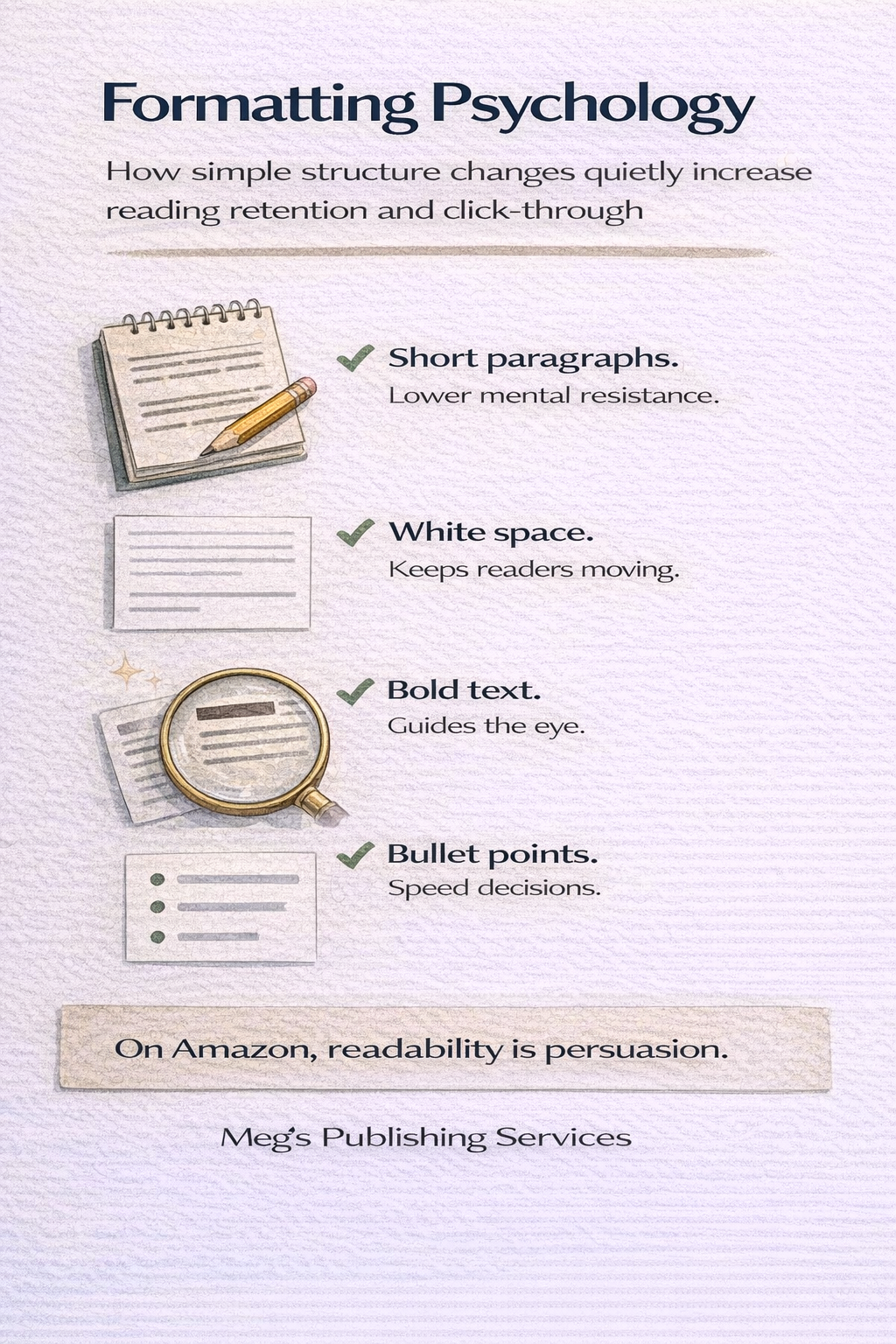
Most authors obsess over what their description says.
Very few think about how it feels to read.
Yet on Amazon, formatting often matters as much as wording. Sometimes more because readers don’t just decide based on meaning. They decide based on effort. And formatting determines how much effort the brain expects to expend.
Why readers skim before they read
When a reader opens your book description, they are not committing to read it. They are scanning to see if it’s readable.
The brain performs a fast visual assessment:
Does this look heavy?
Does this look dense?
Does this look like work?
Long, unbroken blocks of text signal effort. Effort triggers resistance. Resistance shortens attention.
Formatting is not decoration. It is a psychological invitation.
The hidden role of line breaks
Line breaks do more than improve aesthetics. They create mental breathing room.
Each break gives the brain permission to continue. It reduces perceived load and increases the likelihood that the reader will keep going.
Descriptions with thoughtful spacing feel calmer. They feel more confident. They feel easier to trust.
When text feels easy, readers stay longer. Staying longer trains the algorithm.
Why bolding works when used sparingly
Bolding is not for emphasis. It is for guidance.
Strategic bolding tells the reader where to focus without forcing them to read everything. It creates signposts in the text and reassures skimmers that value is accessible.
Overuse destroys this effect. When everything is bold, nothing is important.
The best-performing descriptions use bolding as a courtesy, not a spotlight.
Bullet points as decision accelerators
Bullet points work because they shift the reader from exploration to evaluation.
They allow the reader to quickly answer:
What do I get?
Is this relevant?
Is this worth it?
Bullets should surface benefits, not features. They are not summaries. They are checkpoints that reinforce the decision emotionally before logic takes over.
Poor bullet points list content. Strong ones highlight outcomes.
Spacing and perceived credibility
Crowded text feels anxious. Spacious text feels assured.
When a description is tightly packed, readers subconsciously associate it with amateurism or desperation. When there is space, hierarchy, and flow, the book feels professionally positioned.
This perception happens instantly and quietly. Readers rarely notice it consciously, but their behavior reflects it.
Why Amazon responds to structure
Amazon tracks engagement depth. How far readers scroll. How long they stay. Whether they interact with the page.
Good formatting slows the scroll just enough to signal relevance. Poor formatting speeds the exit.
This is why two descriptions with identical wording can perform very differently. Structure changes behavior. Behavior trains the algorithm.
The shift authors need to make
Stop treating formatting as a final polish step. It is part of persuasion.
Words persuade meaningfully. Structure persuades psychologically.
When both work together, the description does less work while achieving more impact.
The takeaway to remember
Readers don’t avoid books because they aren’t interested.
They avoid books that look tiring.
Formatting removes friction.
Friction kills retention.
Retention drives visibility.
On Amazon, how your words appear often matters as much as what they say.