

The Sticky Line Formula
How to craft one unforgettable line that locks interest and quietly boosts conversion by 20%–40%
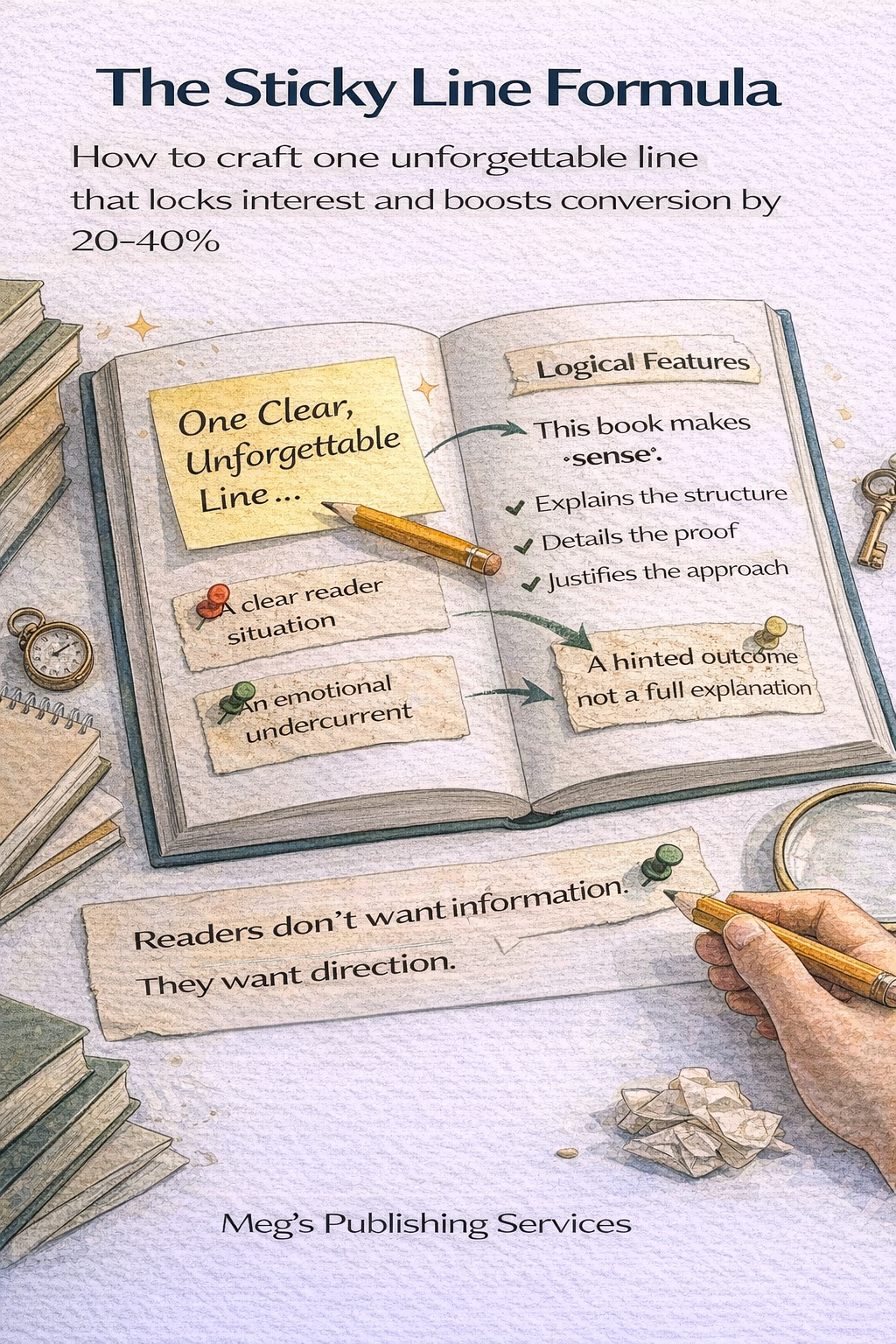
There is always one line in a book listing that decides everything.
Not the cover.
Not the reviews.
Not even the full description.
One line.
It’s the line a reader sees first. The one that makes them pause just long enough to stop scrolling. The one that determines whether they lean in or move on.
Most authors don’t realize this line exists. And because they don’t recognize it, they waste it.
Why one line matters more than the rest of the page
When a reader lands on your Amazon page, they are not reading in sequence. They are scanning for permission to care.
Their attention is fragile. They are tired of options. They want the decision to be easy.
That first line is not there to inform. It is there to hook orientation. To say, “Stay here. This might be what you’re looking for.”
If that line is generic, safe, or explanatory, the reader’s brain disengages. Not consciously. Instantly.
The problem with most opening lines
Most descriptions open with background.
They explain the topic.
They introduce the subject matter.
They describe the scope of the book.
This feels polite. It also feels ignorable.
Explanations require patience. Sticky lines create curiosity. And curiosity is the only thing that slows a scrolling reader down.
What makes a line “sticky”
A sticky line does not try to impress. It tries to resonate.
It usually does one of three things:
It names a familiar frustration with uncomfortable accuracy.
It challenges an assumption the reader already holds.
It promises a specific shift in how the reader will see their problem.
What it does not do is explain everything. It opens a loop instead of closing one.
The reader should feel a quiet tug. A subtle “wait… what?” moment.
Why Amazon responds to sticky lines
Amazon tracks behavior at a granular level. How long readers stay. Whether they scroll. Whether they continue reading.
A strong first line increases dwell time. It encourages micro-commitments. It signals relevance.
Those signals compound. A reader who stays ten seconds longer than average teaches Amazon that the page is doing its job.
That is where the conversion lift comes from. Not magic. Alignment.
The formula most authors never use
The most effective sticky lines tend to combine three elements:
A clear reader situation
An emotional undercurrent
A hinted outcome, not a full explanation
When all three are present, the line feels inevitable. It sounds like the thought the reader was already having but hadn’t articulated yet.
That recognition is powerful. It creates trust before credentials ever enter the picture.
Why clarity beats cleverness every time
Many authors try to be clever with their opening line. Metaphors. Vague philosophy. Poetic statements.
Clever lines get admired. Clear lines get clicked.
Sticky lines are not flashy. They are precise. They sound simple because they are well aimed.
They make the reader feel like the book was written for them, not for everyone.
The takeaway to remember
You don’t need a better description.
You need a better first line.
One line that earns attention.
One line that feels personal.
One line that gives the reader a reason to stay.
When that line works, the rest of the page finally gets a chance to do its job.
That single moment of pause is often the difference between invisibility and traction.