

The Silent Death of a Bad Launch
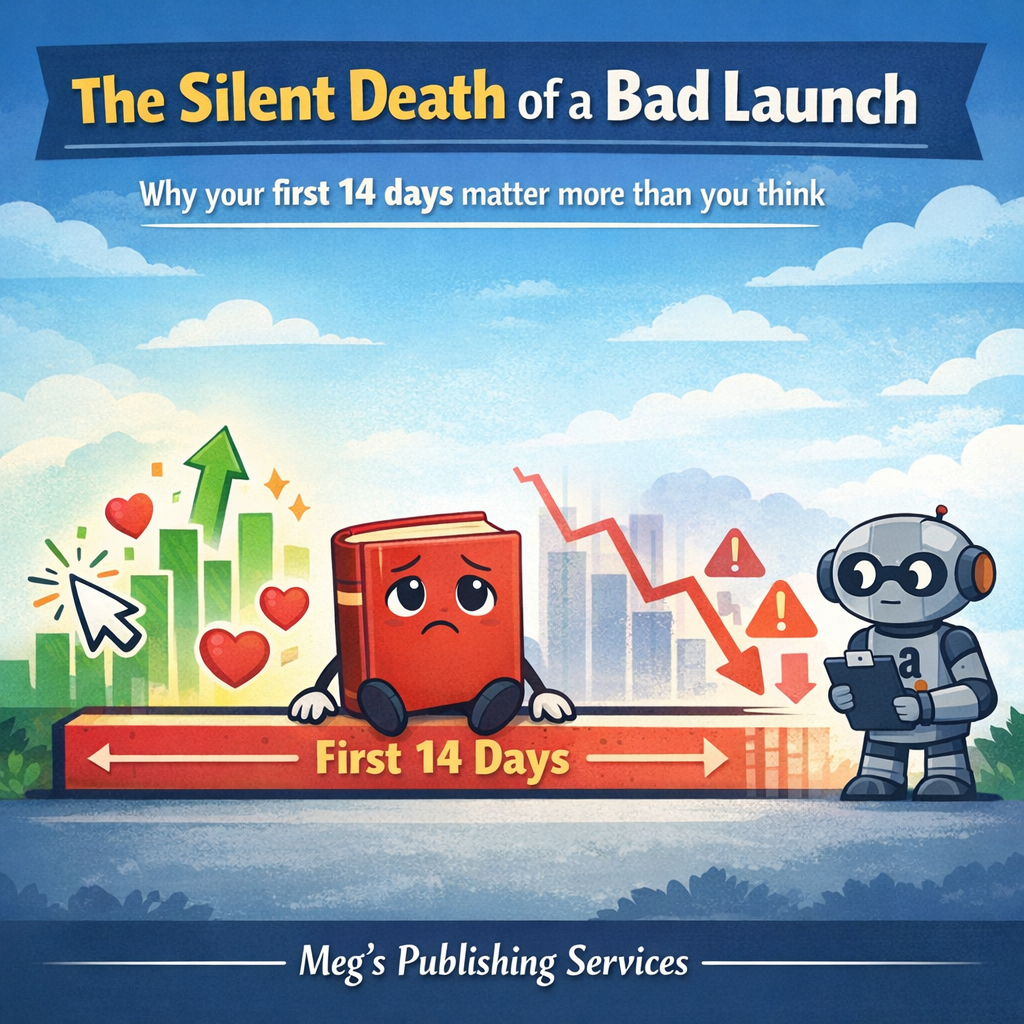
Most books don’t fail in obvious ways.
They don’t crash on release day.
They aren’t rejected by Amazon.
They don’t collect bad reviews or public criticism.
They simply fade.
The most dangerous part is that the author often doesn’t realize the damage has already happened. From the outside, it looks like “nothing is wrong.” Inside Amazon’s system, a quiet decision has already been made.
On Amazon, the first 14 days of a book’s life matter far more than most authors realize. That short window doesn’t just affect launch results. It quietly shapes how much effort the system will ever put into that book again.
The comforting myth authors believe
Many authors see a launch as just the starting line. If things move slowly, they assume they can fix it later with ads, promotions, or a smarter strategy once the book is live.
That belief feels reassuring. It is also inaccurate.
Amazon does not treat books as neutral forever. It forms early opinions, and those opinions become reference points. When the system decides how to treat your book months later, it does not forget what it saw at the beginning.
What Amazon is actually watching in the first two weeks
During the first 14 days, Amazon pays close attention, not just to sales, but to behavior.
It looks at how often your book is clicked when shown.
It tracks how many of those clicks turn into purchases.
It observes how readers interact with your product page.
It notes whether interest builds or fades quickly.
This window tells Amazon whether your book creates momentum or resistance. Strong early signals teach the system that your book deserves continued exposure. Weak signals teach it to proceed carefully.
Caution, in Amazon’s world, looks like silence.
Why “nothing happening” is the worst outcome
Authors often worry when a launch goes badly. Surprisingly, the most damaging launches are not dramatic failures. They are flat ones.
Low clicks.
Low engagement.
Little to no movement.
These signals tell Amazon that even when the book is shown, readers are not responding. When the system sees indifference, it quietly shifts its attention elsewhere. There is no alert. No warning. Visibility simply tapers off.
How suppression actually begins
Suppression is not a punishment. It is a prediction.
Amazon predicts that showing your book is inefficient compared to other options. Other books perform better when given the same space, so your book is gradually deprioritized.
This explains why some authors later do “everything right” and still struggle. Ads are running. Promotions are clean. The page looks decent. The system is still working from an early impression it has never had a reason to revise.
Why ads cannot always rescue a weak launch
Running ads after a soft launch feels logical, and sometimes it helps. Often, it does not.
Ads amplify what already exists. When a product page converts poorly, ads do not create belief. They surface weaknesses faster. Amazon does not cleanly separate paid performance from organic behavior. Poor on-page engagement still feeds into how the book is classified and shown.
Ads perform best when they reinforce momentum, not when they attempt to manufacture it from nothing.
The emotional cost no one warns authors about
A weak launch doesn’t just hurt visibility. It quietly drains confidence.
Authors begin questioning the book itself. The idea. The writing. The market. In many cases, the book was never the problem. Timing, positioning, or preparation were the real issues.
By the time that becomes clear, the emotional energy required to relaunch properly is often gone. Bad launches deplete two things at once: algorithmic trust and human motivation.
What strong launches do differently
Strong launches are not louder. They are clearer.
The right readers find the book early.
They click with confidence.
They stay on the page.
They buy.
Amazon learns quickly where the book belongs and who it serves. That early clarity becomes a long-term advantage, not because of hype, but because of alignment.
The truth most authors need to hear
A launch is not marketing theatre. It is training data.
The first two weeks teach Amazon how to treat your book for months, sometimes years. Preparation matters more than excitement. Clarity matters more than volume. Rushing to publish often costs more than waiting ever would.
The takeaway
Books do not die loudly on Amazon. They die quietly.
Once a book is categorized as low priority, reversing that judgment takes far more effort than most authors expect. A strong launch does not guarantee success, but a weak one almost always guarantees an uphill battle.
On Amazon, early signals echo. And the system has a very long memory.