

The Conversion Funnel Inside Your Description
The invisible sequence readers walk before they ever click “Buy”
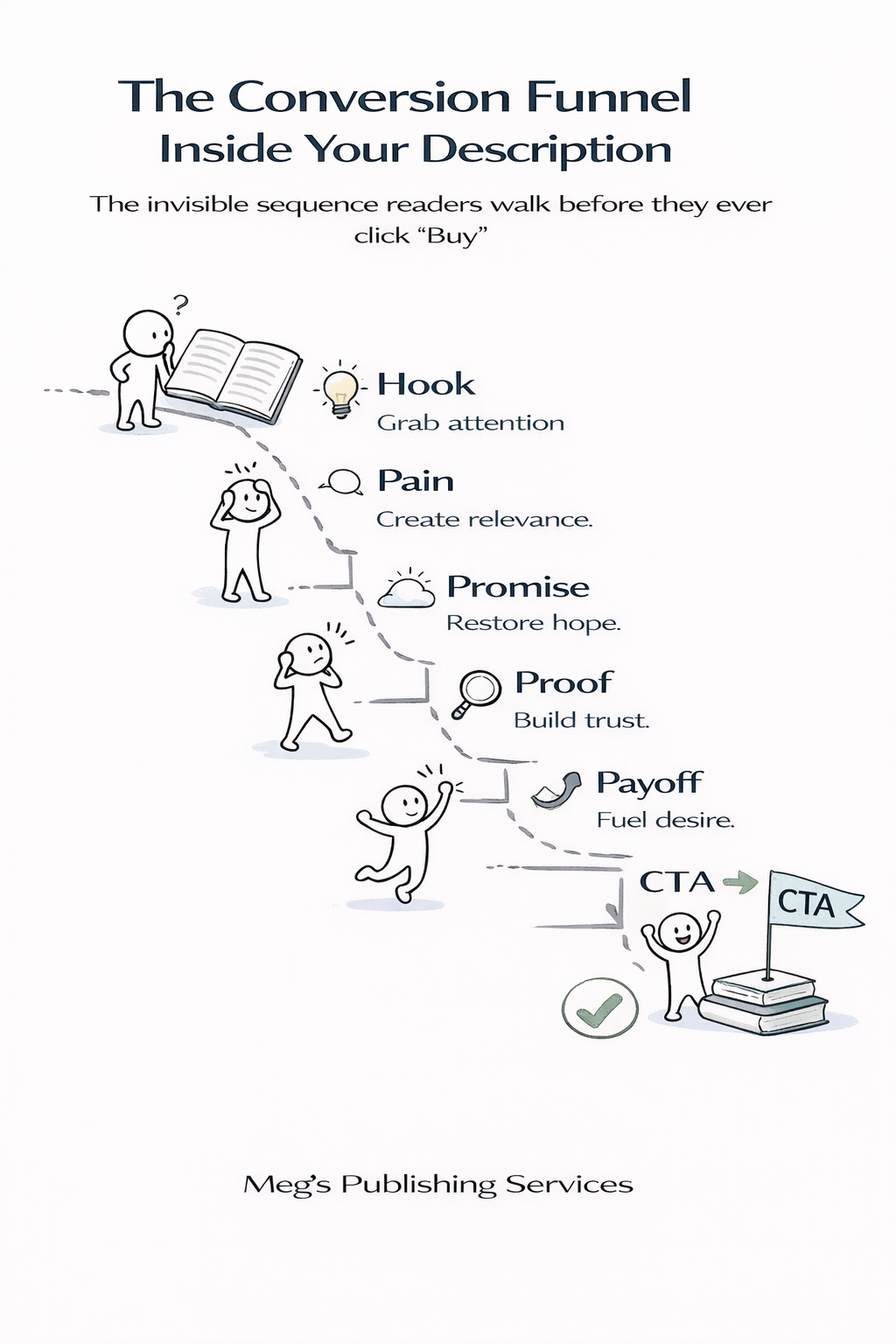
By the time Elena published her book, she had rewritten the description at least six times.
Each version was clearer than the last.
More polished.
More accurate.
And every time she refreshed the dashboard, the numbers stayed stubbornly the same.
Clicks came in.
Sales didn’t.
What bothered her most was that nothing looked wrong. The cover was solid. The topic was in demand. Reviews were kind. If someone asked her what the book was about, she could explain it perfectly.
But readers weren’t asking.
They were leaving.
The moment Elena stopped explaining and started watching
One night, frustrated, Elena opened her own book page and pretended she’d never seen it before.
She didn’t read it.
She skimmed it.
And for the first time, she noticed what the page actually felt like.
It opened politely.
It explained the concept.
It described the structure.
It never grabbed her.
Nothing in the first few lines made her stop and think, “This is about me.” It assumed interest instead of earning it.
That’s when Elena realized something uncomfortable.
Her description wasn’t broken.
It was skipping steps.
Readers don’t jump. They walk.
Elena had written as if readers arrived ready to buy.
They don’t.
They arrive cautious, distracted, and skeptical. And before they ever consider purchasing, they move through a quiet internal sequence. Miss one step, and the whole journey collapses.
Not because readers are cruel.
Because humans don’t like effort without payoff.
The hook isn’t clever. It’s confrontational.
The first thing Elena changed wasn’t the wording. It was the purpose of the opening line.
Instead of introducing the book, she confronted the reader with a truth they already lived with.
Not a metaphor.
Not a slogan.
A recognition.
A hook doesn’t invite readers in.
It stops them mid-scroll.
It says, “You. Yes. This problem you’ve been circling.”
Until that happens, nothing else matters.
Pain isn’t drama. It’s accuracy.
Once the hook worked, Elena saw something else.
Readers stayed longer, but still hesitated.
So she leaned into the part she’d been avoiding: naming the pain plainly.
Not exaggerated.
Not emotional for effect.
Just precise.
The kind of pain readers recognize instantly because it’s theirs.
Pain isn’t about making people uncomfortable.
It’s about proving you understand them.
When readers feel understood, they keep reading.
Promise is where hope enters — carefully
Elena had always been afraid of promises. She didn’t want to oversell.
But she learned that promise doesn’t mean guarantees. It means orientation.
It tells the reader what direction things move after the last page.
Not miracles.
Not transformations overnight.
Just change that feels plausible.
Promise is the bridge between pain and trust.
Without it, readers feel exposed but not supported.
Proof doesn’t persuade. It reassures.
Only after the reader felt seen and hopeful did logic finally have a role.
This is where Elena used to start.
Now it came later.
Proof wasn’t about credentials.
It was about grounding the promise in reality.
Subtle signals.
Small confirmations.
Enough to let the reader think, “Okay. This isn’t wishful thinking.”
Proof doesn’t lead the decision.
It lets the reader feel smart for making it.
Payoff is where the reader imagines themselves changed
Elena almost skipped this part entirely.
But this was where conversions finally turned.
She stopped talking about the book and started talking about after the book.
What feels easier.
What stops looping.
What finally makes sense.
The payoff isn’t informational.
It’s experiential.
Readers don’t buy books to learn things.
They buy them to leave a problem behind.
The CTA isn’t pressure. It’s permission.
At the end, Elena didn’t shout. She didn’t push.
She simply closed the loop.
A calm invitation.
A signal that it was okay to stop searching.
CTAs work when the reader already wants to say yes but needs the moment acknowledged.
Why this sequence works when others fail
When Elena rebuilt her description around this internal funnel, she didn’t add fluff or tricks.
She respected how decisions are actually made.
Readers stayed longer.
Scroll depth increased.
Conversions followed.
Amazon noticed before she did.
Because Amazon doesn’t reward good explanations.
It rewards completed journeys.
The takeaway that matters
A book description is not text.
It’s movement.
Hook earns attention.
Pain creates relevance.
Promise restores hope.
Proof builds trust.
Payoff creates desire.
CTA removes hesitation.
Skip a step, and readers fall off.
Follow the sequence, and the page finally does what it was meant to do.
Not explain the book.
But move the reader forward.