

Category Stacking for Visibility
A short, funny story about chairs, crowds, and why sitting smart beats sitting proud
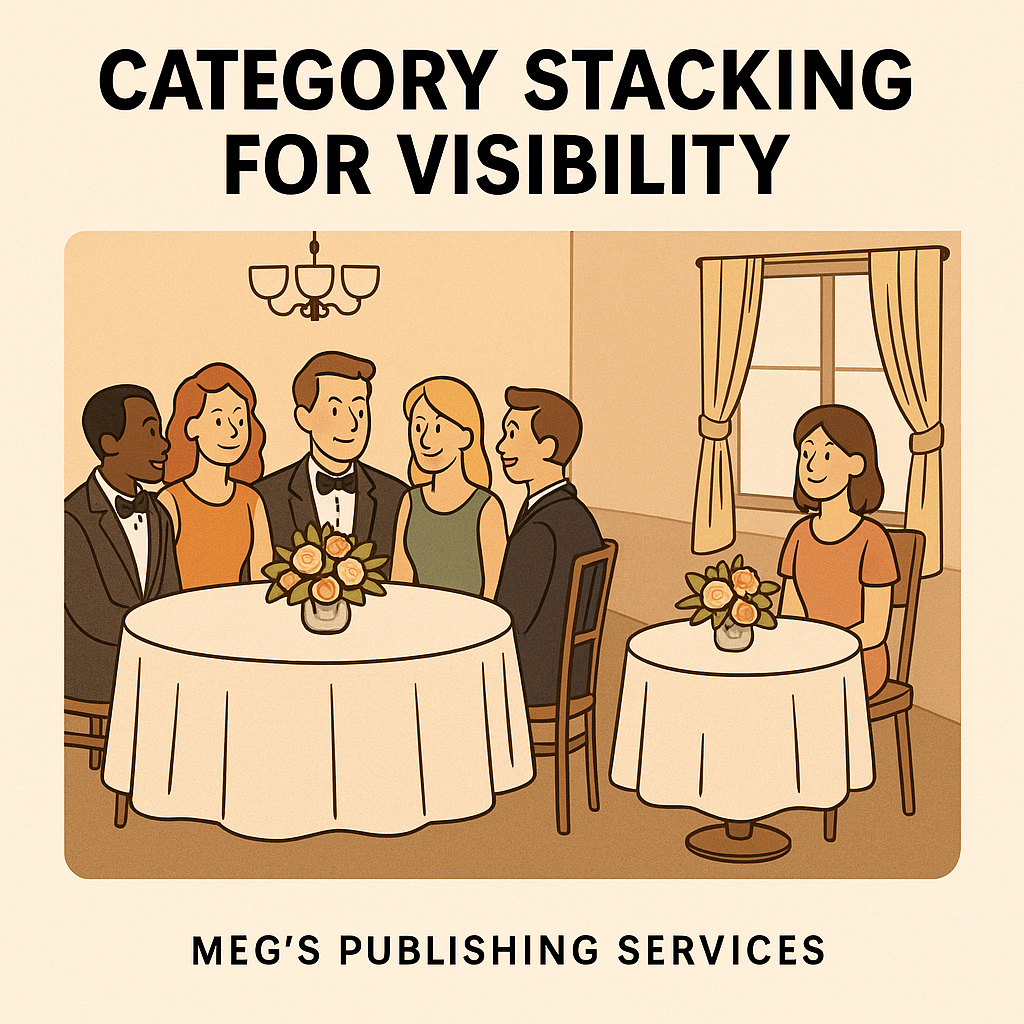
Imagine you walk into a crowded wedding reception.
There’s one table right in the middle of the hall.
Bright lights.
Best dressed guests.
The “important” people.
The table with the energy of “If you’re not here, are you even doing life?”
Then there’s a smaller table by the window.
Quieter.
Still close enough to gist.
Cool breeze.
Plenty elbow room.
And—very important—you can actually chew your food in peace.
Now imagine you insisting on squeezing into the middle table…
You’re half-standing.
Your elbow is inside someone else’s coat.
And because you’re wedged between three shoulders and a stack of handbags…
Nobody can even see you.
That, my friend, is what a lot of authors do with categories.
They don’t choose a shelf.
They choose an ego seat.
The “One-Category” Mistake (i'.e. “I must sit at the popular table”)
Authors are told, “Pick the best category.”
So they do.
They pick the biggest one. The most competitive one. The one that sounds impressive when they say it out loud like a title:
“Oh, my book is in Business & Money.”
“Mine is in Literary Fiction.”
“Mine is in Self-Help.”
And then… silence.
They start wondering why:
people aren’t clicking
rankings don’t move
Amazon is acting like it didn’t even notice their existence
visibility feels stuck like a wig glue that has fully set
And here’s the painful part:
It’s not because the book is bad. It’s because the book chose one chair and expected it to do two jobs:
prove it belongs
prove people care
One chair can’t carry that burden. Not in a crowded hall.
What Amazon Actually Notices (and it’s not vibes)
Amazon doesn’t reward bravery. It rewards patterns.
Amazon is not watching your dreams. It’s watching your data.
It’s quietly asking questions like:
Are people clicking?
Are they staying on the page?
Are they buying?
Is the book moving consistently anywhere at all?
So when your book appears in a competitive category and shows strong movement somewhere else, Amazon finally perks up.
It thinks:
“Hmm. This book belongs here…”
“…and readers are reacting over there.”
That combo is catnip to the algorithm.
Because now you’re not just claiming identity. You’re showing evidence.
One signal says relevance. The other says momentum.
And that is where category stacking quietly wins—without noise, without begging.
Category Stacking, Explained Like You’re Five
Think of it this way:
One category is your address.
The other is your proof of life.
The competitive category tells Amazon:
“This is the neighborhood my book lives in.”
The lower-competition category tells Amazon:
“And look—people are actually visiting.”
Without the first, you can look random.
Without the second, you can look invisible.
Together, they tell a complete story:
“This book fits… and it’s moving.”
And movement is Amazon’s love language.
Why Two Categories Beat One (Every Time)
Because readers don’t scroll forever.
In the big category, your book is standing beside giants:
books with 10,000 reviews
authors with entire fanbases
titles that have been camping on page one since 2017
You’re not weak. You’re just new.
So you stack.
You keep your book in the big, relevant room—because yes, that’s where it belongs. But you also give it a second shelf where it can breathe, rank, and get noticed long enough for Amazon to start pushing it harder.
It’s the difference between:
“I’m here, please notice me.”
and“I’m here… and the numbers are speaking.”
What Category Stacking Is NOT (because people love to misbehave)
Let’s be very clear before somebody hears “stacking” and starts doing nonsense.
Category stacking is not:
choosing random tiny categories that have nothing to do with your book
chasing #1 badges like it’s a personality trait
hiding from competition
misrepresenting your topic just to “rank”
Because if the two categories don’t serve the same reader, the stack collapses.
It becomes confused placement. Confused placement kills conversion.
Stacking only works when both shelves make sense for the same audience—just at different crowd levels.
Same reader. Different room sizes.
Three Sticky Takeaways You’ll Remember
1) One category shows who you are. The other shows that readers care.
Amazon needs both.
Your ego needs only one.
Choose wisely.
2) Visibility grows where relevance and movement meet.
Not where competition is loudest.
Not where you feel most important.
Where the data is most convincing.
3) Two honest categories beat one impressive one—every single time.
Because algorithms don’t clap for confidence.
They respond to evidence.
Amazon is not your auntie at Christmas shouting, “That’s my girl!”
Amazon is a cold system that says, “Show me results.”
Final Thought
You don’t need the best seat in the room.
You need:
one seat that proves you belong
and one seat where people actually notice you
That’s category stacking.
Not flashy nor dramatic. Just smart.
And smart compounds.
While others are fighting for air at the “popular table,” you’re by the window… eating… ranking… and getting picked up by the algorithm like,
“Oh. This one is moving.”
Now you’re not just sitting.
You’re being seen.