

Barcodes Decoded
Why Most Authors Buy Them Unnecessarily — And How to Place Them Correctly
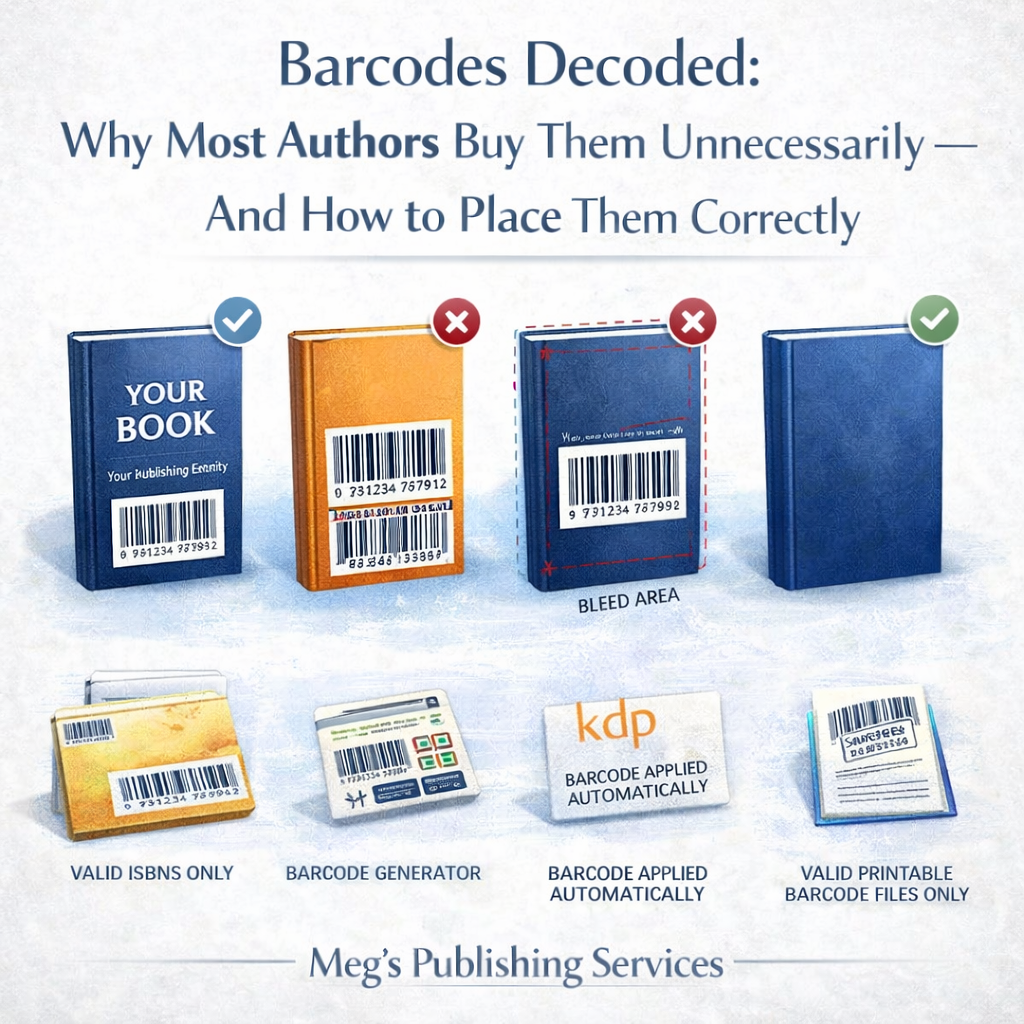
Barcodes are one of the most misunderstood parts of book publishing.
Authors either panic-buy them too early or ignore them completely or let designers place them incorrectly and hope for the best.
None of those approaches work long term.
Let’s clean this up properly in one place.
ISBN vs store barcodes are not the same thing
This is the root confusion.
An ISBN identifies the book.
A barcode helps retailers scan and sell the physical product.
The barcode is simply a machine-readable representation of the ISBN, usually in EAN format.
Buying an ISBN does not automatically mean you need to buy a barcode separately.
That depends on how and where you publish.
Why most authors buy barcodes unnecessarily
Many authors buy barcodes because:
A designer asked for one
They saw it listed as a requirement somewhere
They assumed ISBN and barcode must always be purchased together
In reality, most print-on-demand platforms generate barcodes automatically.
If you are using:
Amazon KDP for paperback or hardcover
IngramSpark for distribution
You usually do not need to buy a separate barcode.
Buying one early often solves nothing and adds cost without benefit.
KDP’s automatic barcode
Amazon KDP automatically generates and places a barcode on your print book.
That barcode:
Is linked to the ISBN used on the book
Meets Amazon’s retail requirements
Does not require extra payment
For most KDP-only authors, this is enough.
Problems only arise when:
Designers place graphics where the barcode should go
The cover trim is changed after layout
The barcode area is not left clear
These are design coordination issues, not barcode failures.
IngramSpark barcode requirements
IngramSpark also provides barcodes if you choose that option during setup.
Their requirements are stricter because they distribute to:
Bookstores
Libraries
Wholesalers
Key points:
The barcode must be scannable
It must be placed on a light background
It must not be distorted or resized
It must sit in a clear zone on the back cover
Most IngramSpark rejections are caused by placement, not the barcode itself.
POD placement problems authors don’t anticipate
Here is where things go wrong.
Common placement mistakes include:
Putting the barcode too close to the trim edge
Placing it over textured or dark backgrounds
Shrinking it to “look nicer”
Rotating it to fit design symmetry
Forgetting spine width changes affect placement
A barcode that looks fine visually can still fail scanning tests.
Print systems care about function, not aesthetics.
When you actually must generate your own barcode
You need to generate your own barcode if:
You are offset printing outside POD systems
A distributor explicitly requires a publisher-supplied barcode
You are selling through channels that do not auto-generate one
You need full control over placement across multiple printers
This is not the default case for most authors.
Buying barcodes “just in case” usually creates confusion, not flexibility.
Cover design and publishing identity are connected here
Barcode handling is not just a technical issue.
It reflects how professionally the book was set up.
When ISBN, trim size, cover design, and distribution are misaligned:
Barcodes fail
Files get rejected
Print costs increase
Launch timelines slip
These issues rarely come from one mistake.
They come from treating setup decisions in isolation.
Final thought
Barcodes are tools, not trophies.
You do not earn credibility by buying them early.
You earn credibility by using them correctly, at the right stage, for the right distribution path.
If you are unsure whether your barcode setup, placement, or platform choice is correct, pause before printing more copies.
If you want your cover design, ISBN, and barcode setup handled cleanly across KDP and IngramSpark, reach out to Meg’s Publishing Services.
We help authors avoid technical mistakes that derail otherwise solid books.