

What POD Really Means
Most Authors Misunderstand It Completely
Print-on-Demand sounds simple.
Upload a file.
Books get printed when someone orders.
That surface understanding is why so many POD books are built wrong.
POD is not a shortcut.
It is a system.
And systems punish traditional thinking.
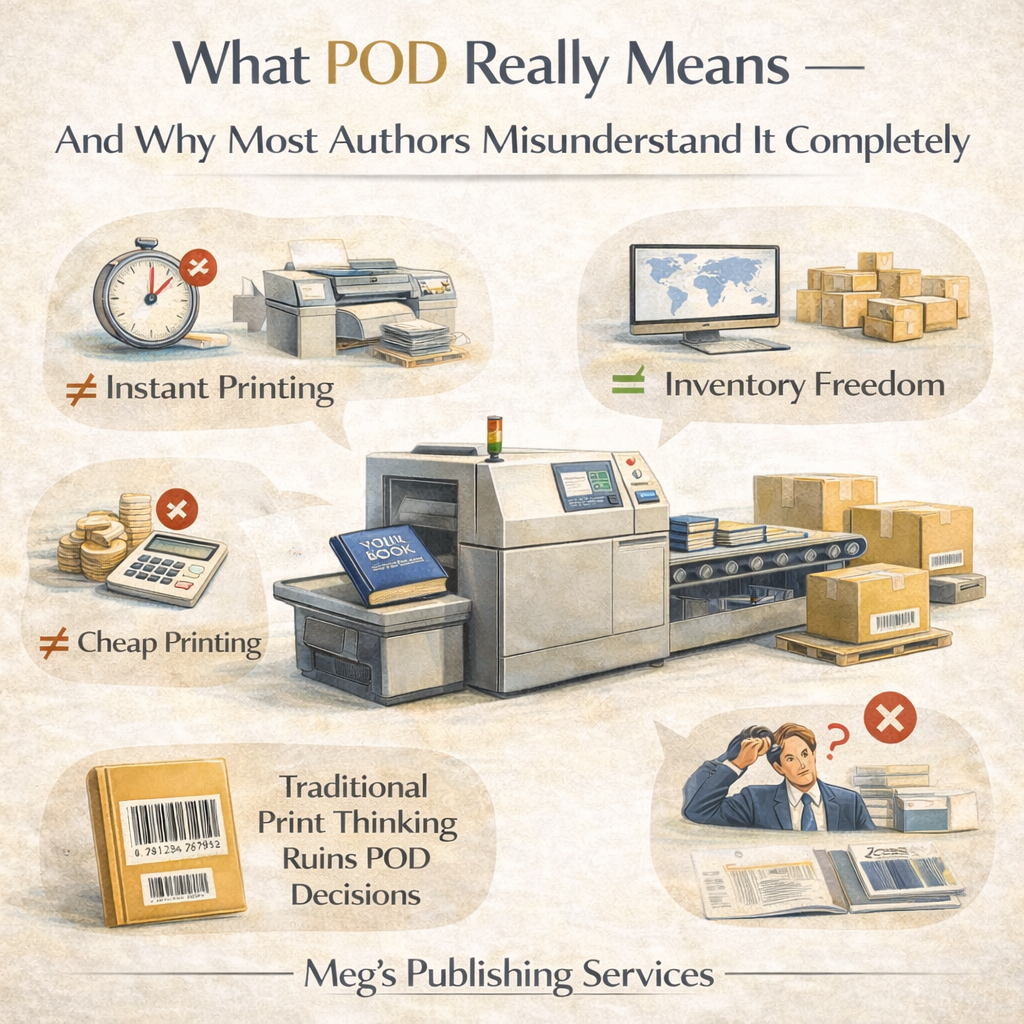
POD does not mean instant printing
Nothing about POD is instant.
A POD book moves through:
File validation
Printer allocation
Trim and paper matching
Bindery scheduling
Distribution routing
Each step is automated, not rushed.
When authors design as if POD works like a local print shop, they make choices that slow everything down later.
POD favors precision, not speed thinking.
POD does not mean cheap printing
This is another myth that ruins decisions.
POD optimizes risk, not unit cost.
Offset printing is cheaper per copy when you print thousands.
POD is cheaper when you want zero inventory, zero storage, and zero unsold stock.
Authors who chase “cheap per copy” inside POD usually:
Choose bad trim sizes
Pick inappropriate paper
Design covers that inflate print costs
Price books incorrectly
POD rewards sustainability, not bulk logic.
POD means automated inventory freedom
This is the real value.
With POD:
You do not pre-print
You do not warehouse
You do not guess demand
You do not manage stock levels
The system prints only what sells.
That freedom is powerful, but only if the book is built to work inside automated constraints.
Traditional print thinking tries to control everything.
POD requires alignment instead.
Why traditional print thinking breaks POD books
Traditional print thinking asks:
How many copies should I print?
How do I reduce per-unit cost?
How do I make the book feel premium at all costs?
POD thinking asks:
How will this file behave across printers?
How does trim size affect routing?
How does page count affect pricing?
How will distribution systems handle this book?
When authors ignore those questions, they get:
Rejected files
High print costs
Distribution limits
Books priced out of their market
The book may look good.
It is just built wrong.
POD is a distribution decision, not a printing one
This is the mindset shift most authors miss.
POD is not about ink and paper.
It is about how your book moves.
Every choice affects:
Which printers can produce it
Which countries can fulfill orders
How fast delivery happens
Whether bookstores will accept it
How returns are handled
Designing a POD book without understanding distribution is like building a car without considering roads.
Why POD mistakes compound quietly
POD mistakes rarely stop a launch.
The book uploads.
Sales happen.
Everything seems fine.
The problems appear when:
You expand distribution
You add bookstores
You scale ads
You publish more titles
You move internationally
Fixing POD mistakes later often means rebuilding files, not tweaking settings.
Final thought
POD is not “print when ordered.”
It is automated publishing infrastructure.
When you build for the system, POD gives you freedom.
When you fight it with traditional print logic, it quietly limits you.
If your POD setup was rushed or based on assumptions, it is worth reviewing before you scale further.
If you want your POD formats and distribution built correctly from the start, reach out to Meg’s Publishing Services.
We help authors build books that work with the system, not against it.