

Why KDP POD and Ingram POD Are Not the Same
How the Difference Affects Bookstores, Quality, and Reach
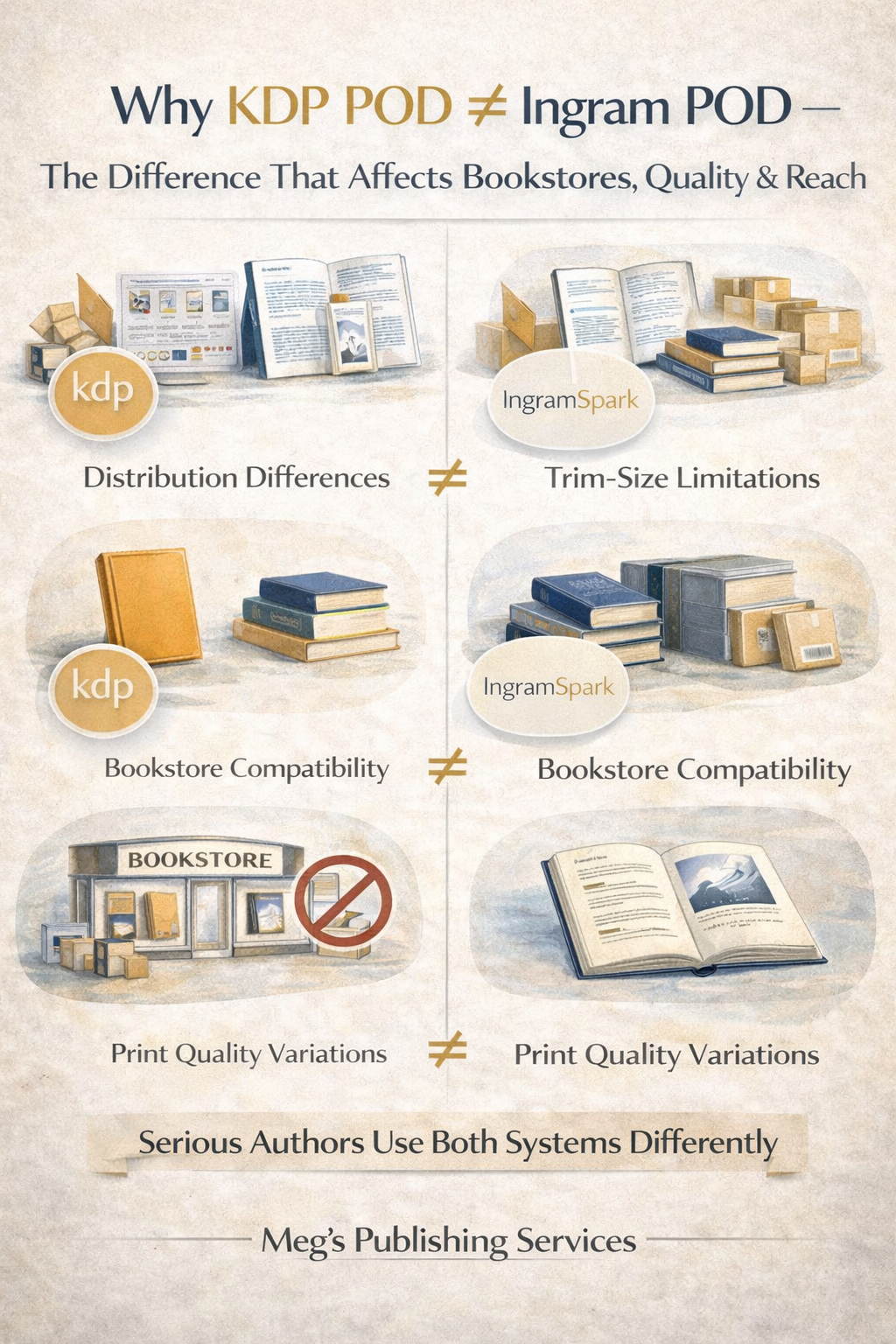
Authors often assume KDP POD and Ingram POD are duplicates.
They are not.
They solve different problems, serve different systems, and reward different decisions. Treating them as interchangeable is one of the fastest ways to limit a book’s reach without realizing it.
Let’s clear this up cleanly.
Distribution is the real difference
KDP POD is optimized for Amazon’s retail ecosystem.
Ingram POD is built for global trade distribution.
That distinction changes everything.
KDP prioritizes speed and integration inside Amazon.
Ingram prioritizes compatibility with bookstores, libraries, wholesalers, and international supply chains.
If your goal is Amazon only, KDP works.
If your goal includes bookstores and libraries, Ingram is not optional.
Bookstore compatibility is not equal
Bookstores generally do not order from Amazon.
They order from Ingram.
That is not personal. It is operational.
When a book is only available through KDP:
Bookstores cannot order it easily
Returns are restricted
Wholesale discounts are limited or unavailable
When a book is set up correctly through Ingram:
It appears in bookstore ordering systems
It supports standard trade discounts
It aligns with return policies bookstores expect
A book can look professional and still be structurally unavailable to stores.
Trim size limitations quietly matter
KDP offers a limited set of trim sizes that work well for Amazon fulfillment.
Ingram supports a wider range of trim sizes that align with:
Bookstore shelving standards
Library catalog expectations
Traditional publishing norms
Choosing a trim size without considering distribution locks the book into certain channels by default.
This is not a design decision.
It is a system decision.
Print quality is not identical
Both systems print acceptable books.
They do not print the same way.
Differences show up in:
Paper stock options
Cover finish consistency
Color reproduction
Binding feel across print runs
Readers may not articulate it, but buyers notice patterns.
Authors targeting bookstores, libraries, or premium markets usually need Ingram’s print consistency. Authors focused on Amazon sales often prioritize KDP’s speed.
Neither is superior. They serve different outcomes.
Why serious authors use both systems differently
Experienced authors do not choose between KDP and Ingram as an either or decision.
They assign roles.
KDP is often used for:
Amazon retail efficiency
Faster fulfillment
Lower friction inside one ecosystem
Ingram is used for:
Bookstore access
Library distribution
International reach
Trade credibility
Trying to make one system do the other’s job causes friction.
The mistake that causes most frustration
Authors upload the same files, same trim, same settings to both platforms and expect identical results.
Then they face:
Bookstore resistance
Higher print costs
Distribution confusion
Quality complaints
Rejections they cannot explain
The systems are not mirrors. They are different machines.
Final thought
Your book does not just need to look right.
It has to be built right for the systems it will travel through.
KDP POD and Ingram POD are tools.
Using the wrong tool for the wrong job limits reach quietly.
If you are unsure how to structure your POD setup across platforms, pause before publishing more titles.
If you want your POD formats and distribution strategy aligned correctly across Amazon KDP and IngramSpark, reach out to Meg’s Publishing Services.
We help authors build books that work with distribution systems, not against them.