

KDP vs IngramSpark: Why They Are Not the Same (And Never Will Be)
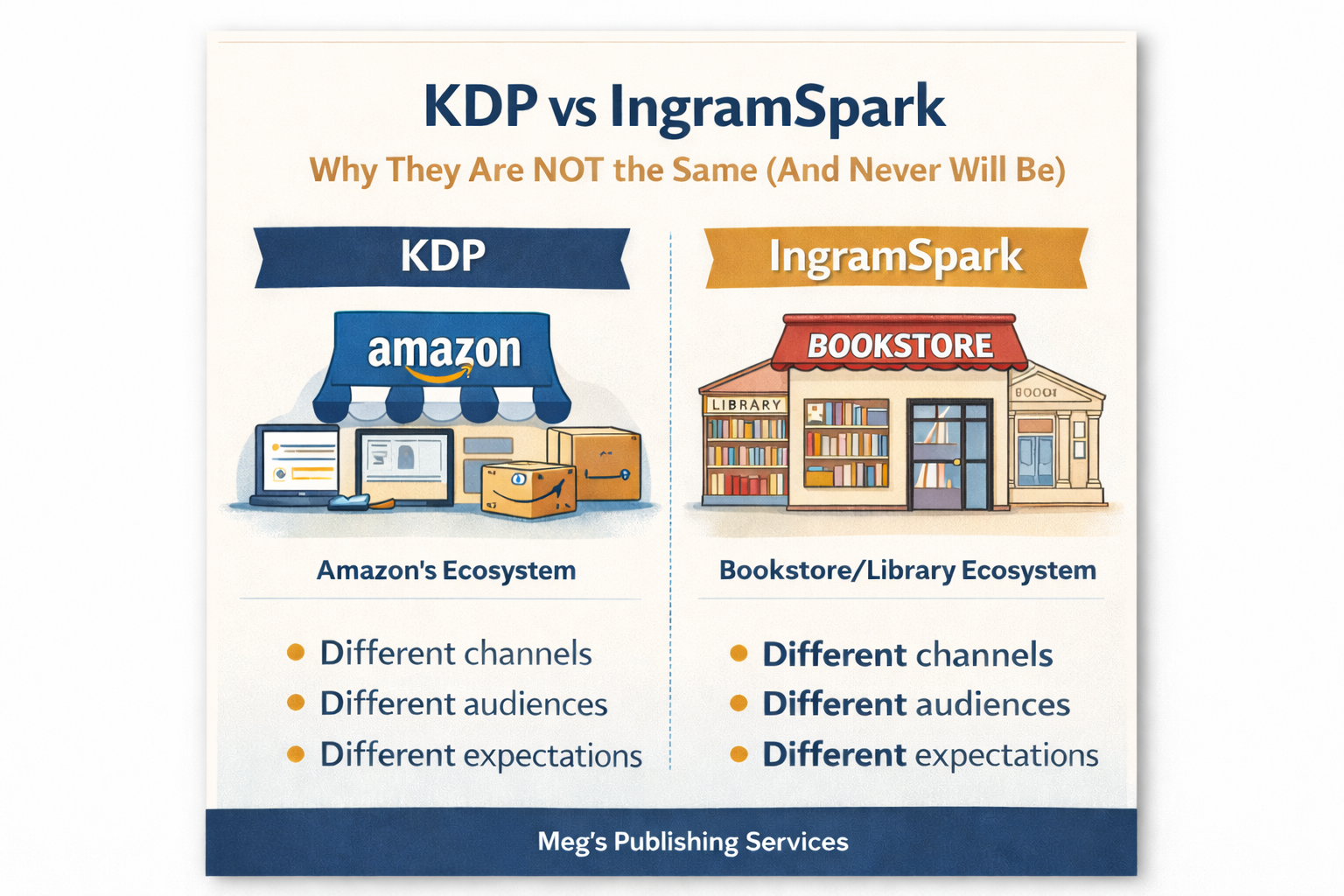
Many authors are told one dangerous sentence early in publishing: “Just upload everywhere.” It sounds practical. It sounds efficient. It is also wrong.
Distribution is not a button. It is a strategy. And KDP and IngramSpark were never designed to do the same job.
KDP Is Amazon’s Ecosystem
KDP exists to serve Amazon. Everything about it is optimized for Amazon’s retail machine: speed, convenience, customer fulfillment, and internal discoverability. When you publish through KDP, your book is built primarily for Amazon shoppers who already intend to buy books online.
That is not a flaw. It is a feature.
KDP works best when your goals are Amazon visibility, fast fulfillment, and frictionless sales inside one ecosystem. It assumes your audience is already shopping on Amazon and that Amazon is the center of your distribution world.
IngramSpark Is the Bookstore and Library Ecosystem
IngramSpark exists to serve the global book trade. Bookstores, libraries, wholesalers, academic institutions, and international distributors rely on Ingram’s infrastructure to source books.
This ecosystem values different things: trade discounts, returnability, catalog credibility, print consistency, and predictable supply chains. It is not optimized for speed. It is optimized for compatibility and trust.
When a book is built correctly for IngramSpark, it can move through systems that Amazon does not control and does not prioritize.
Different Channels Mean Different Audiences
Amazon buyers are impulse-driven, price-sensitive, and convenience-oriented. Bookstore and library buyers are selection-driven, quality-conscious, and policy-bound.
These audiences behave differently. They notice different things. They expect different standards.
A book optimized for Amazon does not automatically translate well to bookstores. A book built for bookstores often feels over-engineered for Amazon. Pretending the audiences are the same leads to frustration on both sides.
Different Expectations Shape Everything
KDP tolerates narrow discounts, limited return options, and Amazon-centric metadata. IngramSpark expects industry-standard discounts, return policies, and metadata that aligns with trade catalogs.
Trim size choices, pricing flexibility, cover finishes, and even ISBN decisions are interpreted differently inside each system. The same book file can be perfectly acceptable in one ecosystem and quietly rejected or ignored in the other.
This is not inconsistency. It is design.
Why “Upload Everywhere” Creates Hidden Damage
When authors upload the same files, settings, and expectations to both platforms, they often experience subtle but costly problems: bookstores that cannot order the book, libraries that skip it entirely, pricing that makes no sense outside Amazon, or print quality complaints they cannot explain.
Nothing looks broken at first. Sales may still happen. But distribution stalls quietly.
The damage shows up later when authors try to scale, expand, or reposition their work.
How Strategic Authors Use Both Systems
Experienced authors do not choose between KDP and IngramSpark as rivals. They assign roles.
KDP handles Amazon efficiently. IngramSpark handles the wider book trade. Each system is used for what it was built to do, not what authors wish it could do.
That separation is not complexity. It is clarity.
Final Thought
KDP and IngramSpark are not duplicates. They never were. They serve different ecosystems, different audiences, and different expectations.
Your book’s distribution should be intentional, not accidental. When distribution is treated as strategy instead of a checkbox, authors stop fighting systems and start using them properly.
If you are unsure whether your current setup is limiting your book without you realizing it, that uncertainty is already a signal.
Meg’s Publishing Services helps authors design distribution strategies that respect how these systems actually work, not how they are marketed.