

Why Bookstores Rarely Order KDP Books
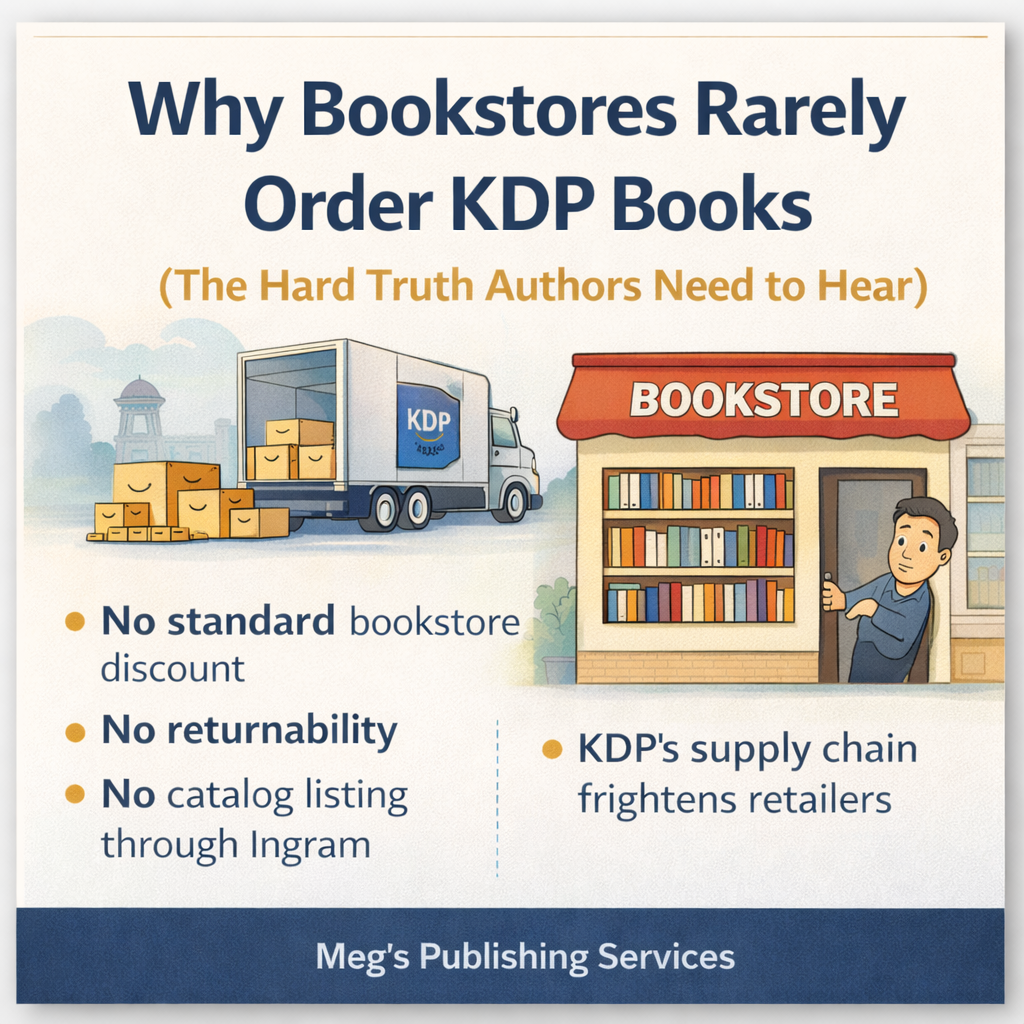
The Hard Truth Authors Need to Hear
Many authors dream of walking into a bookstore and seeing their book on a shelf. They publish on KDP, hear that their book is “available worldwide,” and assume bookstores can simply order it.
That assumption is where the disappointment begins.
Bookstores rarely order KDP books, not because the books are bad, but because the system they are built on works against how bookstores operate.
Bookstores Expect Standard Trade Discounts
Bookstores survive on margins. They expect books to come with industry-standard wholesale discounts that leave room for profit after overhead, staffing, and unsold inventory.
KDP does not operate on traditional trade discount structures. Its pricing and margin logic are optimized for Amazon’s direct-to-consumer model, not for third-party retail resale.
When a bookstore looks at a KDP-listed title, the math often does not work. If the numbers do not make sense, the book is skipped, regardless of quality or demand.
Returnability Is Not Optional in Bookstores
Bookstores rely on returns. It is how they manage risk.
Unsold books are sent back to distributors so stores are not stuck absorbing full losses. This is standard practice in the book trade.
KDP does not support traditional bookstore returnability in the way retailers expect. From a bookstore’s perspective, that means all the risk sits with them.
Most bookstores will not take that risk. They simply choose another title that fits their operational model.
No Catalog Presence Through Ingram
Bookstores do not browse Amazon to source inventory. They order from catalogs and ordering systems tied into distributors like Ingram.
If a book is not properly listed through Ingram’s catalog system, it effectively does not exist to most bookstores.
A KDP-only book lacks that native catalog presence. Staff cannot easily search it, assess it, or order it through their normal workflows.
Convenience matters. If a book is hard to order, it will not be ordered.
KDP’s Supply Chain Frightens Retailers
Bookstores are wary of Amazon as a supplier.
Amazon is not just a distributor. It is also a direct competitor. Ordering books that route through Amazon’s supply chain introduces uncertainty around fulfillment, timing, and long-term dependence on a rival platform.
For bookstores, this is not emotional. It is strategic.
They prefer distributors built for the trade, not retailers built for consumers.
Why Authors Misread the Situation
From the author’s side, everything looks fine. The book is live. It has an ISBN. It can be found online. Technically, it is “available.”
From the bookstore’s side, the book does not meet core requirements around discounting, returns, catalog access, and supply reliability.
Nothing is broken.
The systems are simply misaligned.
What This Means for Authors Who Want Physical Stores
If bookstore presence matters to you, KDP alone is not enough.
That does not mean KDP is useless. It means it was never designed to serve bookstores.
Serious authors treat KDP as one channel, not the channel. They build distribution intentionally, using systems that bookstores already trust and understand.
Final Thought
Bookstores are not rejecting authors. They are rejecting friction.
When a book does not fit the mechanics of how bookstores buy, stock, and return inventory, it is quietly passed over.
If your goal includes physical bookstore presence, your distribution choices must reflect that reality.
Meg’s Publishing Services helps authors structure their distribution so bookstore dreams are supported by bookstore mechanics, not wishful thinking.