

When Authors MUST Use IngramSpark and When It’s a Waste of Money
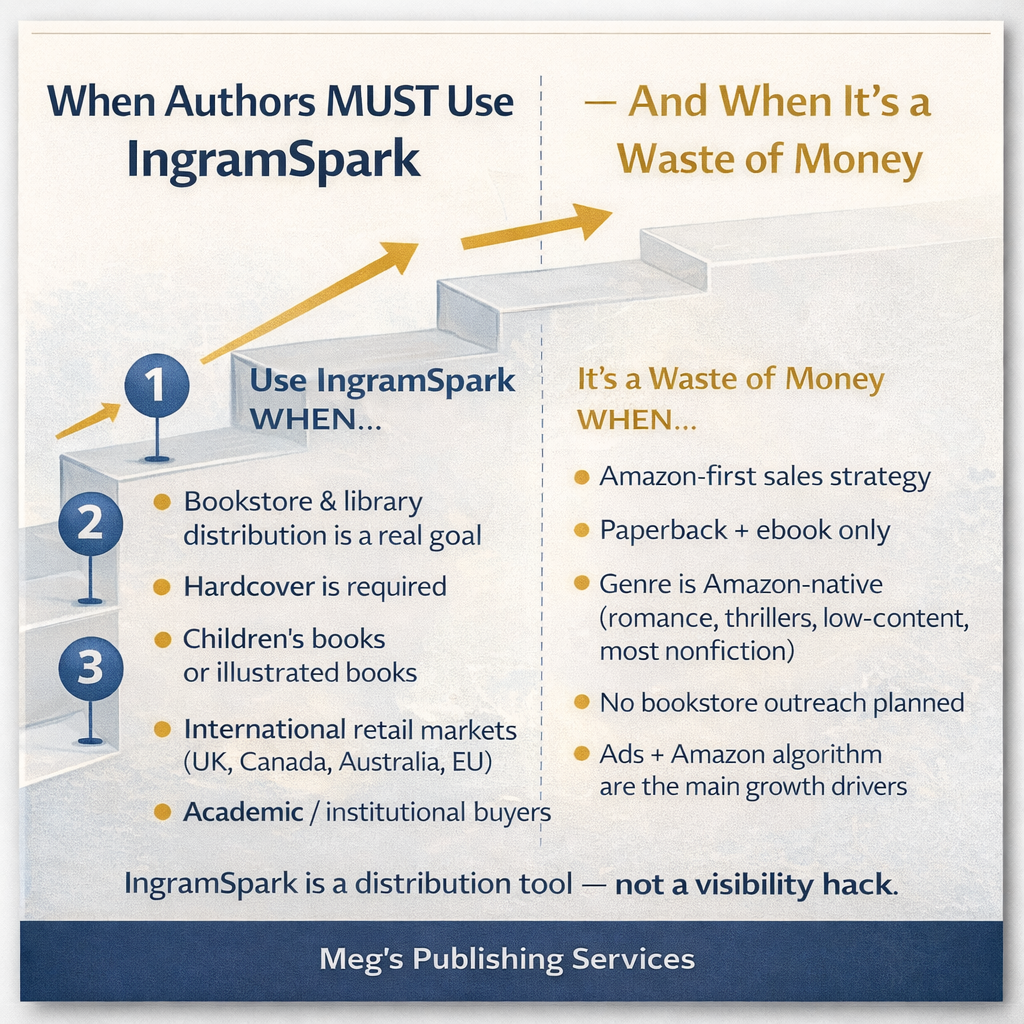
IngramSpark is one of the most misunderstood tools in publishing.
Some authors are told they must use it or they are “not serious.” Others are warned to avoid it because it is “expensive” or “complicated.” Both extremes are wrong.
IngramSpark is neither mandatory nor useless. It is situational.
Knowing when to use it and when to skip it saves money, frustration, and false expectations.
When IngramSpark Is the Right Choice
IngramSpark makes sense when your goals extend beyond Amazon and into the traditional book trade.
If your book is meant for bookstores, libraries, schools, or institutions, IngramSpark is often necessary. These buyers order through established trade systems, not retail platforms. Ingram’s catalog presence, discount structures, and return options align with how those buyers operate.
IngramSpark also performs better for certain formats. Hardcover books, children’s books, large print editions, and visually sensitive titles tend to benefit from Ingram’s wider trim options and trade-oriented setup. These formats are more commonly requested by libraries and physical stores, where Ingram already has trust and infrastructure.
Genre matters too. Nonfiction, educational titles, memoirs, children’s books, and regional-interest books often see stronger opportunities through trade channels than through Amazon alone.
In these cases, IngramSpark is not optional overhead. It is access.
When IngramSpark Becomes a Waste of Money
IngramSpark becomes unnecessary when your goals do not require the trade ecosystem.
If your book is:
Primarily an ebook
Focused on Amazon buyers
Part of a digital-first or ads-driven strategy
Not intended for bookstores or libraries
A short-term or experimental project
Then KDP alone is often enough.
Uploading to IngramSpark without a clear reason usually leads to disappointment. Authors pay setup fees, adjust pricing for trade discounts, and enable returns, only to realize they never had a plan to reach bookstores in the first place.
Ingram does not create demand. It only removes barriers if demand already exists or is being pursued intentionally.
Markets Where Ingram Outperforms Amazon
Amazon dominates online retail. Ingram dominates trade access.
Ingram performs better in:
Independent bookstores
Chain bookstores
Public and academic libraries
Schools and universities
International book markets that rely on trade wholesalers
If your book needs to appear in those spaces, IngramSpark offers reach Amazon does not prioritize.
If your audience lives online and buys directly, Amazon usually outperforms Ingram.
The Cost Authors Rarely Calculate Correctly
IngramSpark’s costs are not just monetary. They include:
Pricing adjustments to allow discounts
Return risk
Tighter metadata expectations
Slower iteration cycles
Those costs only make sense when aligned with a clear distribution goal.
Using IngramSpark “just in case” often drains resources without delivering results.
The Strategic Way to Decide
The real question is not “Should I use IngramSpark?”
The real question is “Who needs to buy this book, and how do they normally buy books?”
If the answer involves bookstores, libraries, institutions, or international trade partners, IngramSpark is usually worth it.
If the answer is Amazon shoppers and online readers, KDP-only may be the smarter, leaner choice.
Final Thought
IngramSpark is not a badge of seriousness. It is a tool.
Used with intention, it expands reach and credibility. Used blindly, it creates cost and confusion.
If you are unsure whether IngramSpark supports your actual goals or is just adding complexity, that uncertainty is a sign to pause and reassess.
Meg’s Publishing Services helps authors choose distribution tools based on strategy, not pressure or publishing myths.