

Different Uploads for Different Platforms
Why You Cannot Upload the Same File to KDP and IngramSpark
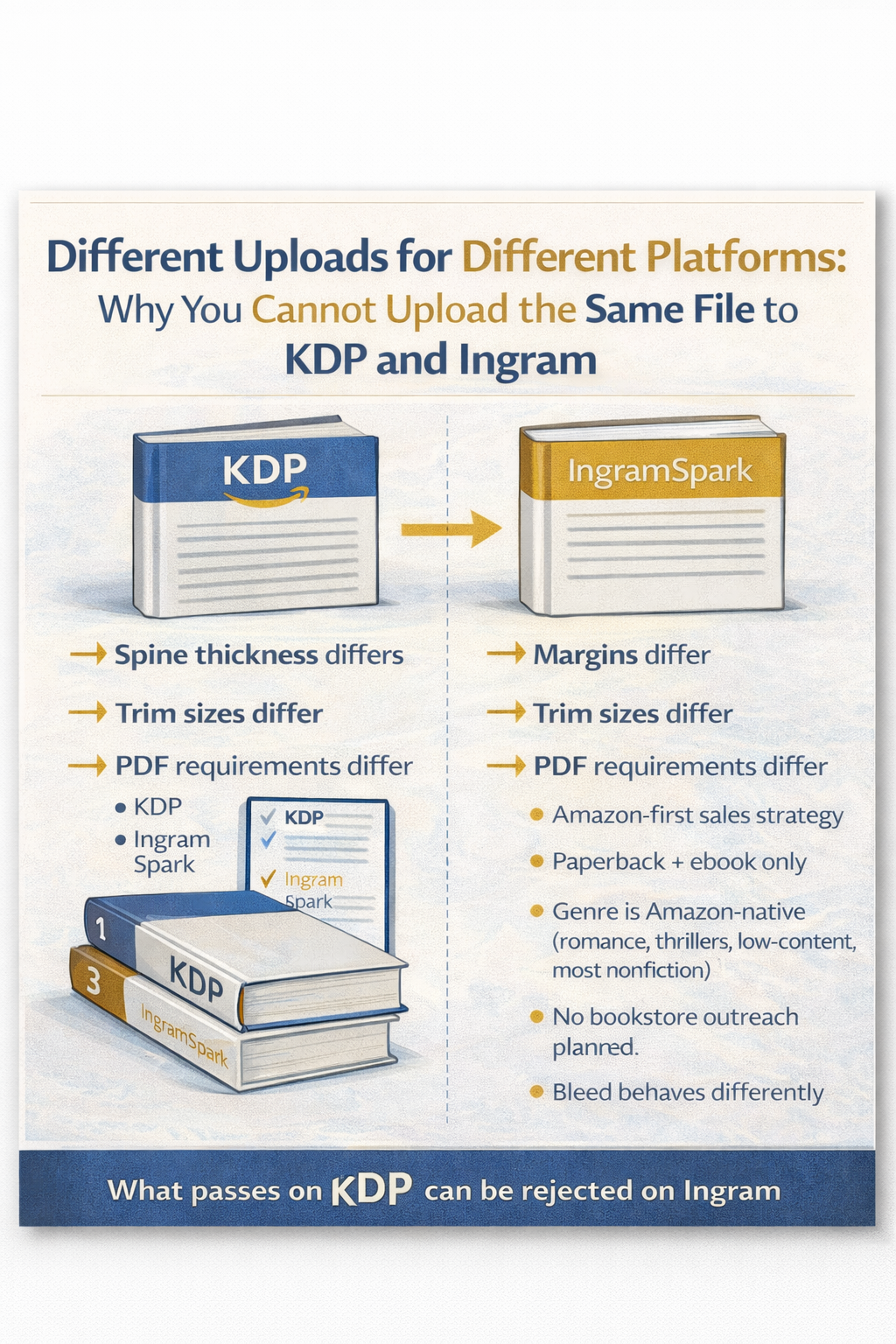
This is one of the biggest shocks for authors who decide to “go wide.”
They assume that once a book file works on one platform, it should work everywhere. After all, it is the same book, the same content, the same cover.
That assumption creates more technical chaos than almost any other publishing mistake.
KDP and IngramSpark are not broken when they reject the same file differently. They are enforcing different rules for different systems.
Spine Thickness Is Calculated Differently
Spine width is not universal. It depends on paper type, print specifications, and how each platform calculates binding tolerances.
A cover that fits perfectly on KDP can be slightly off on IngramSpark, even with the same page count. That small difference is enough to push text off-center, misalign wrap, or trigger rejection.
Nothing dramatic changed. The math did.
Margins Are Not Identical
Interior margin requirements differ between platforms. What passes comfortably on KDP can feel too tight or fail checks on IngramSpark, especially for books with higher page counts.
IngramSpark tends to enforce stricter expectations because its books are routed through bookstores and libraries that care about readability and durability.
Margins are not just design choices. They are part of print integrity.
Trim Sizes Do Not Fully Overlap
Both platforms offer multiple trim sizes, but the overlap is not complete.
Some trim sizes supported on KDP are not supported on IngramSpark and vice versa. Choosing a trim size without checking compatibility often locks the book into one platform by accident.
When authors later try to upload the same files elsewhere, they discover the trim size itself is the problem, not the file quality.
PDF Requirements Are Not the Same
Each platform validates PDFs differently.
Color handling, embedded fonts, transparency, image resolution, and bleed settings may pass on KDP and fail on IngramSpark. Ingram’s checks are generally more conservative because its files move through a wider trade network.
A file passing review does not mean it is universally compliant. It means it met that platform’s standards.
Bleed Behaves Differently Across Systems
Bleed is one of the most common failure points.
Both platforms require bleed when designs reach the edge, but how bleed is measured, checked, and tolerated differs. A bleed margin that squeaks by on KDP can be flagged on IngramSpark if it falls outside exact specifications.
This is not inconsistency. It is enforcement.
Why This Always Feels Like a Shock
From the author’s perspective, the book looks fine. It printed once. It sold copies. Everything feels approved.
Then another platform rejects the same files and gives technical feedback that feels confusing or overly strict.
What authors are really encountering is this truth: there is no such thing as a universal POD file.
Each system has its own tolerances, priorities, and downstream responsibilities.
What This Means for Authors Going Wide
Going wide is not just a distribution decision. It is a production decision.
Books meant to live comfortably across platforms must be built with:
Platform-aware trim choices
Separate cover calculations
Interior margins that respect stricter standards
Files validated for multiple systems, not just one
This is not over-engineering. It is professional preparation.
Final Thought
KDP and IngramSpark are not rivals. They are different machines solving different problems.
Uploading the same file everywhere assumes those machines work the same way. They do not.
When authors treat distribution as strategy instead of convenience, technical chaos disappears.
Meg’s Publishing Services helps authors prepare clean, platform-specific files so their books move smoothly instead of getting stuck in avoidable rejections.