

The Cost Differences That Blindside Authors
Print Fees, Discounts, and Returns Explained Clearly
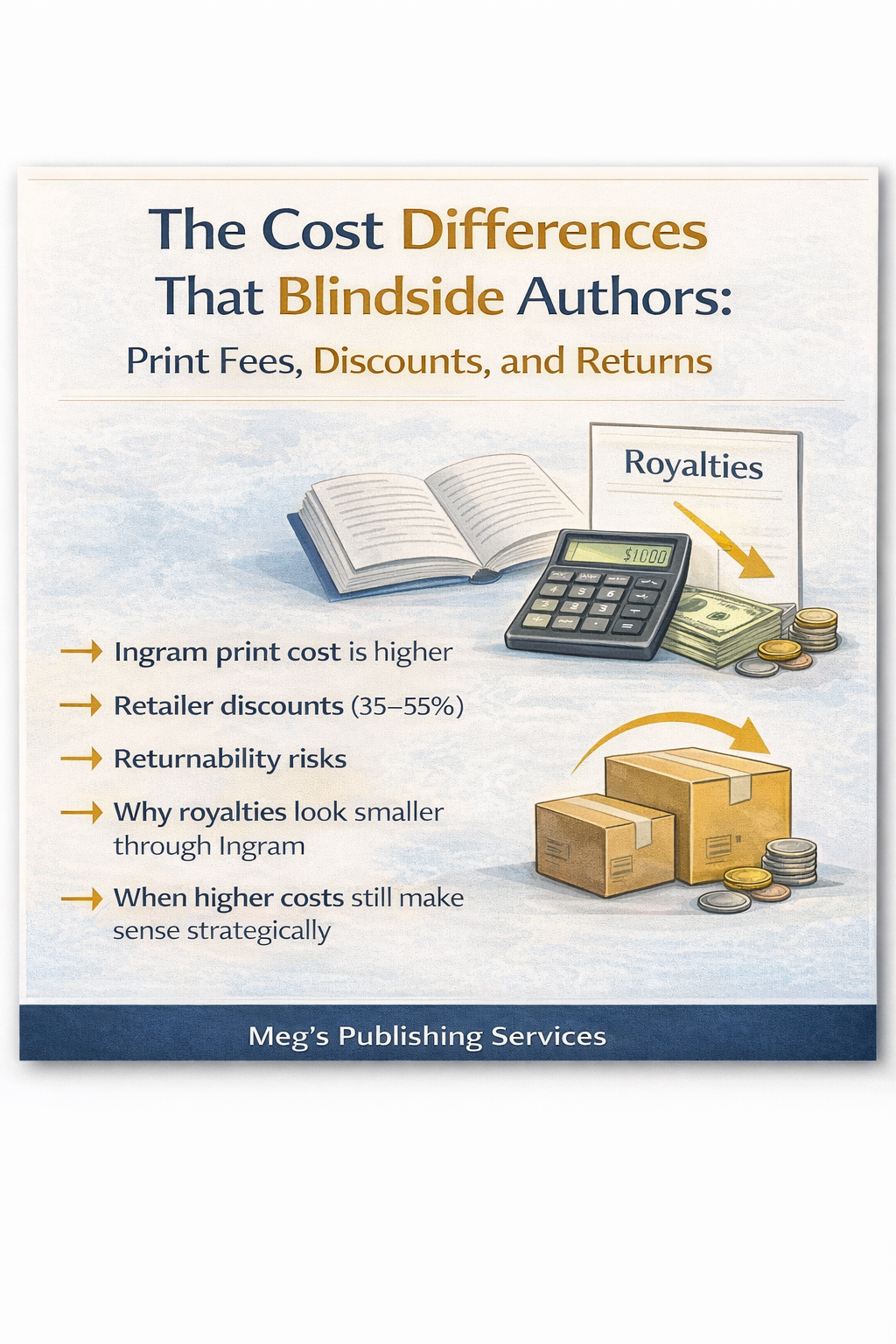
Money surprises hurt more than technical ones. Many authors step into wider distribution expecting similar costs and royalties across platforms, only to feel blindsided when the numbers look very different. Nothing is wrong. The systems are simply built for different economic realities.
Understanding these costs upfront removes fear and replaces it with control.
Why IngramSpark’s Print Costs Are Higher
IngramSpark’s per-unit print cost is usually higher than KDP’s. That is not inefficiency. It reflects trade-grade printing standards, broader trim options, and infrastructure designed for bookstores and libraries, not just direct-to-consumer shipping.
KDP optimizes for Amazon’s scale and speed. Ingram optimizes for compatibility across many buyers. Those priorities show up in print costs.
Higher print cost does not mean lower value. It means the book is being produced for a different supply chain.
How Retailer Discounts Really Work
Bookstores expect wholesale discounts. Standard trade discounts typically fall between 35% and 55% off the retail price.
These discounts are not penalties. They are how physical retailers stay in business.
KDP is not built around this model. IngramSpark is.
When authors enable trade discounts through Ingram, they are choosing access to physical retail channels. That access has a price, and the discount is part of it.
Returnability and Why It Feels Risky
Returns scare authors because they feel unpredictable. From a bookstore’s perspective, returns are risk management.
Unsold books are returned so stores are not forced to absorb full losses. This is normal trade behavior.
Enabling returns through IngramSpark shifts some risk back to the publisher. That risk is real, but it is also controlled through pricing, demand forecasting, and distribution strategy.
Returns are not mandatory for every book. They are strategic, not automatic.
Why Royalties Look Smaller Through Ingram
When authors compare royalties, IngramSpark payouts often look smaller than KDP’s. This is usually the moment panic sets in.
The difference comes from:
Higher print costs
Wholesale discounts
Potential return exposure
What authors are seeing is not “lost money.” They are seeing the cost of accessing a different market.
Amazon royalties reflect direct retail sales. Ingram royalties reflect trade distribution economics. Comparing them without context creates unnecessary anxiety.
When Higher Costs Still Make Strategic Sense
Higher costs make sense when:
Bookstore presence matters
Library access is a goal
Institutional or bulk sales are planned
Hardcover, large print, or children’s formats are involved
Long-term brand credibility matters more than short-term margin
In these cases, the book is not just a product. It is a channel entry tool.
Lower royalties can still produce higher overall value when they unlock opportunities Amazon alone cannot reach.
When Lower-Cost Distribution Is the Smarter Choice
Lower-cost distribution makes sense when:
Sales are primarily online
Ads drive demand directly to Amazon
The book is digital-first
The project is experimental or short-term
Simplicity matters more than reach
In these scenarios, KDP’s economics align better with the author’s goals.
Final Thought
Costs are not punishments. They are signals.
Different platforms reflect different business models, buyer expectations, and distribution realities. When authors understand what they are paying for, fear disappears and strategy takes over.
If you want help choosing a distribution path that makes financial sense for your specific goals, Meg’s Publishing Services helps authors evaluate costs with clarity, not surprises.