

Why Serious Authors Often Use Both
The Smart Dual-Distribution Strategy
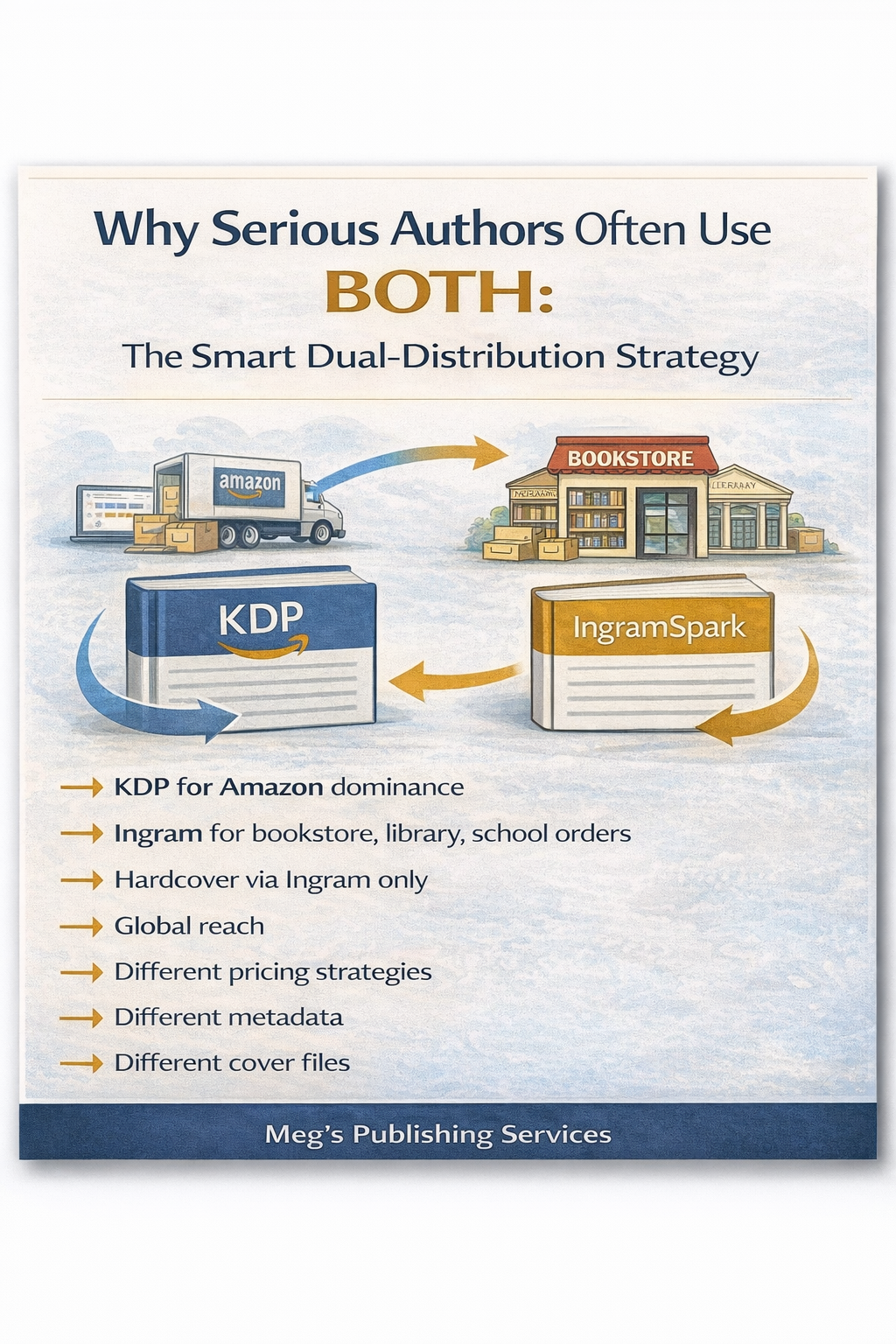
Many authors think distribution is a loyalty decision. Pick one platform. Commit. Hope it works.
That mindset limits reach.
Serious authors treat distribution as architecture, not allegiance. They use multiple systems deliberately because each one does a different job well.
Using both KDP and IngramSpark is not duplication. It is separation of roles.
KDP Handles Amazon Dominance
KDP is built for Amazon’s ecosystem. It excels at visibility inside Amazon, fast fulfillment, algorithmic discoverability, and direct-to-consumer efficiency.
Authors who want strong Amazon performance rely on KDP for:
Amazon retail sales
Faster delivery expectations
Competitive pricing inside one marketplace
Ads and algorithm alignment
KDP is excellent at what it was designed to do. It just was not designed to do everything.
Ingram Handles Bookstores, Libraries, and Schools
IngramSpark serves a different world. Bookstores, libraries, schools, and institutions order through trade systems that Amazon does not control.
Authors who want physical presence use Ingram for:
Bookstore ordering
Library acquisition
School and institutional access
International trade distribution
These buyers care about catalog listings, discounts, return policies, and supply reliability. Ingram was built for those expectations.
Why Many Authors Put Hardcover on Ingram Only
Hardcover behaves differently in the market.
Bookstores and libraries prefer hardcovers through trade channels. Ingram’s infrastructure, trim options, and credibility align better with how hardcover books are stocked, priced, and ordered.
Many authors therefore choose:
Paperback on KDP and Ingram
Ebook on KDP
Hardcover on Ingram only
This is not restriction. It is optimization.
Global Reach Requires More Than One System
Amazon dominates online retail. Ingram dominates global trade distribution.
Authors who want international reach without managing multiple regional printers often rely on Ingram’s network, which routes books through established wholesalers in different countries.
Using both systems increases reach without increasing complexity for the reader.
Pricing Is Not One-Size-Fits-All
Dual distribution requires different pricing strategies.
Amazon pricing is optimized for consumer psychology and ads. Trade pricing must allow for wholesale discounts while still protecting margins.
Serious authors price intentionally:
One price strategy for Amazon
Another for trade channels
Trying to force one price everywhere usually fails somewhere.
Metadata Must Be Platform-Specific
Metadata that works on Amazon is not always sufficient for trade systems.
Amazon prioritizes keywords and categories for shopper discovery. Trade systems prioritize bibliographic accuracy, subject classification, and catalog consistency.
Dual-distribution authors manage metadata separately so each system receives what it expects.
Cover Files Are Rarely Identical
Different platforms mean different tolerances.
Spine calculations, bleed enforcement, barcode placement, and trim availability vary. A cover that passes on KDP can be rejected by IngramSpark without being “wrong.”
Professional setups use:
Platform-specific cover files
Interior margins that respect stricter standards
Separate validations for each system
This prevents endless resubmissions and quiet distribution failures.
Why This Strategy Signals Professionalism
Using both systems correctly shows intent.
It signals that the book was built with:
Multiple buyers in mind
Long-term distribution goals
Real-world supply chains
Professional production standards
Readers may never see this work. Retailers and institutions do.
Final Thought
Serious authors do not ask, “Which platform should I use?”
They ask, “Which system should handle which role?”
KDP and IngramSpark are not competitors. They are components. When each is used for what it does best, distribution becomes predictable instead of stressful.
If you want your dual-distribution setup structured cleanly, with correct pricing, metadata, formats, and files across platforms, Meg’s Publishing Services builds that strategy end-to-end so nothing is left to guesswork.