

The Worst Distribution Mistakes Authors Make
How to Avoid Them Without Burning Time or Money
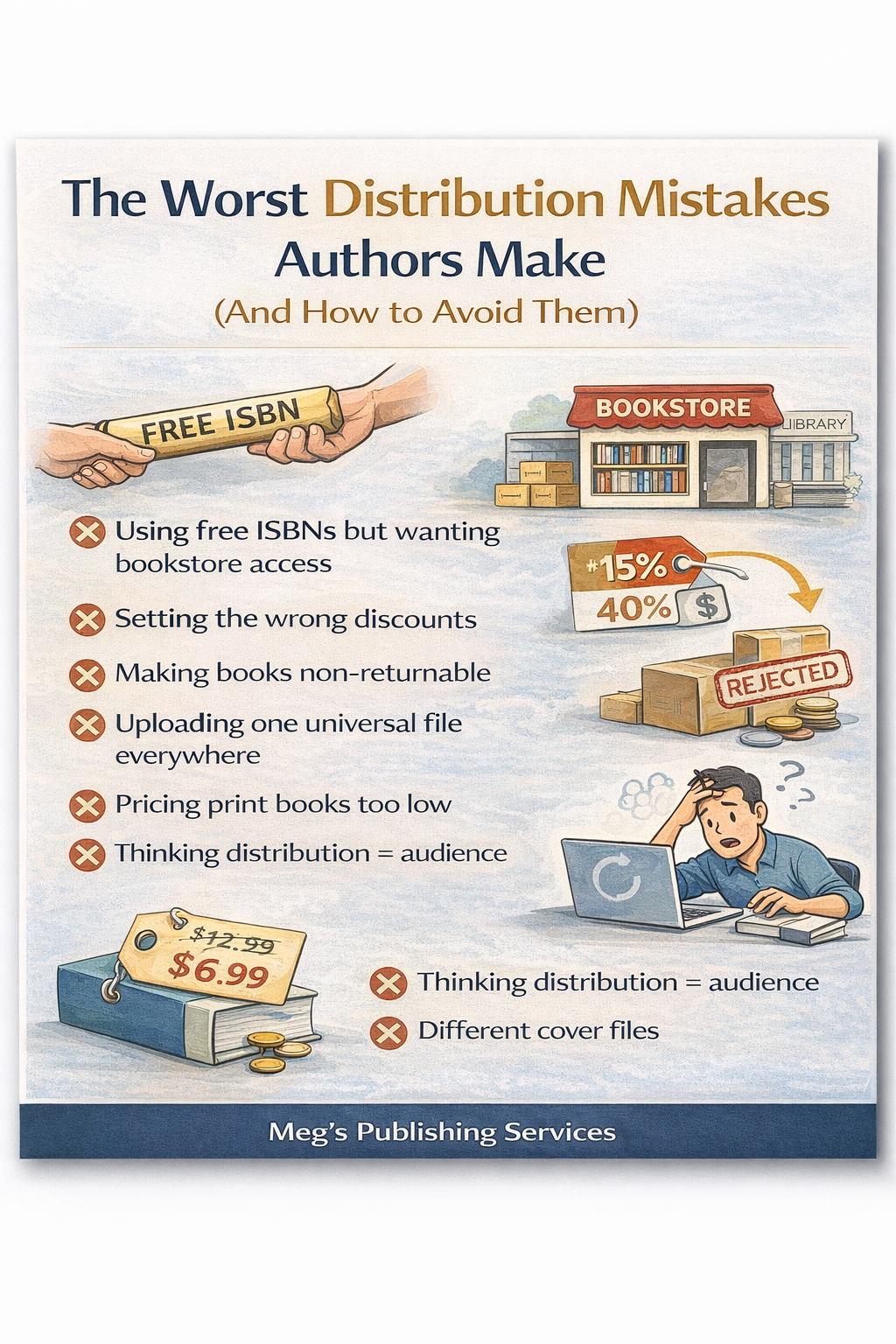
Most distribution mistakes do not look like mistakes at the beginning. They look like efficiency. Convenience. “Getting it done.”
The damage shows up later, when authors try to scale, reach bookstores, or understand why opportunities keep stalling.
These are the mistakes that quietly cost authors the most.
Using Free ISBNs While Expecting Bookstore Access
This is the most common contradiction.
Free ISBNs work inside specific platforms. Bookstores, libraries, and trade buyers operate in a different system. When the publisher of record is not the author or imprint, bookstore access becomes complicated or impossible.
Nothing is broken.
The setup simply does not match the goal.
Avoid this by deciding early whether bookstore and library access matters to you. ISBN choices are distribution decisions, not administrative ones.
Setting the Wrong Discounts
Many authors either avoid discounts entirely or set them without understanding trade expectations.
Bookstores rely on wholesale discounts to manage risk and overhead. Setting discounts too low makes the book unviable for stores. Setting them without pricing correctly destroys margins.
Discounts are not generosity.
They are part of the trade model.
Avoid this by aligning pricing, print costs, and discounts as one system, not three separate choices.
Making Books Non-Returnable Without Understanding the Impact
From an author’s perspective, returns feel dangerous. From a bookstore’s perspective, returns are standard.
Making books non-returnable removes most bookstore risk tolerance. Many stores will not order non-returnable titles, regardless of demand or quality.
Returns are not mandatory for every book, but opting out without understanding the trade consequence quietly removes bookstore access.
Avoid this by treating returnability as a strategic choice, not an emotional one.
Uploading One Universal File Everywhere
This mistake causes endless frustration.
Different platforms have different requirements for trim size, margins, bleed, spine calculations, and PDF validation. A file that passes one system can fail another without being “wrong.”
There is no universal POD file.
Avoid this by preparing platform-specific covers and interiors when distributing across multiple systems.
Pricing Print Books Too Low
Low pricing feels competitive. It is often destructive.
Print books carry fixed costs. Pricing too low leaves no room for:
Print fees
Discounts
Returns
Profit
This leads to tiny royalties, failed trade distribution, or forced price increases later.
Avoid this by pricing print books based on real production and distribution costs, not ebook psychology.
Thinking Distribution Equals Audience
This is the most subtle mistake.
Distribution determines where a book can be bought. It does not create who wants it.
Uploading to more platforms does not create demand. It only removes friction when demand exists.
Authors who confuse access with audience end up everywhere and nowhere at the same time.
Avoid this by separating marketing strategy from distribution mechanics. They support each other, but they are not the same job.
Why These Mistakes Keep Repeating
None of these errors come from laziness. They come from incomplete explanations and oversimplified advice.
Publishing systems are complex because book buying systems are complex. Pretending otherwise leads authors into avoidable traps.
Final Thought
Distribution mistakes rarely fail loudly. They fail quietly. Books remain available but invisible, listed but unstocked, published but constrained.
Avoiding these mistakes does not require perfection. It requires intention.
If you want your distribution choices aligned with your actual goals, rather than working against them silently, Meg’s Publishing Services helps authors build distribution strategies that make sense before problems appear.
That clarity alone is often the difference between frustration and forward momentum.