

How KDP Royalties Actually Work
Not the Fantasy Version Authors Imagine
Most authors think they understand KDP royalties. They’ve seen the percentages. They’ve done quick math in their head. They assume the number Amazon shows is close enough to what they’ll earn.
That assumption is where money confusion begins.
KDP royalties are not intuitive, and they are definitely not generous by default. They are conditional, calculated, and sensitive to decisions most authors don’t realize they’re making.
Let’s break it down properly.
The 70% vs 35% Royalty Is Not a Choice You Simply Select
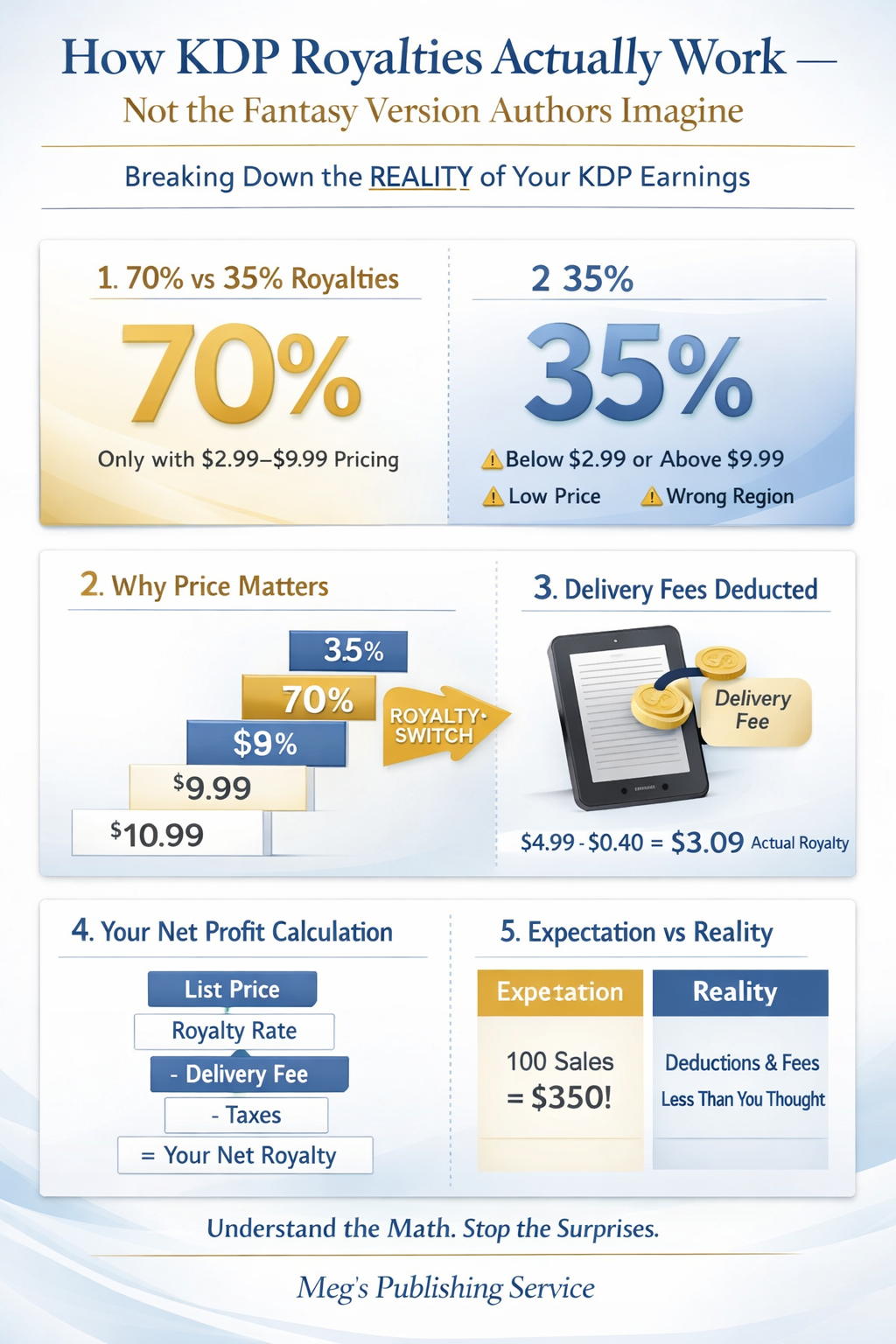
Many authors believe they can just “choose” the 70% royalty. In reality, your book qualifies for it only if it meets specific conditions around pricing, delivery, and marketplace rules.
Price is the first gate. If your ebook is priced too low or too high, it is automatically pushed into the 35% bracket. That means the same book can earn wildly different royalties based purely on price, even before marketing or sales volume enters the picture.
The 35% option is not a punishment. It exists for books that fall outside Amazon’s preferred pricing window. But authors who accidentally land there usually do not realize it until their payouts disappoint them.
Why Price Quietly Controls Your Royalty
Pricing is not just about what readers are willing to pay. It is also about which royalty tier Amazon allows you to access.
A book priced to “sell more copies” can actually earn less per sale than a higher-priced book with fewer buyers. Authors often underprice thinking volume will compensate, without realizing they’ve reduced their royalty percentage at the same time.
This is how authors sell books consistently and still feel broke.
Pricing decisions are royalty decisions, whether you intend them to be or not.
Delivery Fees Are the Part No One Warns You About
This is the shocker.
Under the 70% royalty option, Amazon charges a delivery fee based on file size. The larger your ebook file, the more you pay per sale before royalties are calculated.
This matters most for:
Image-heavy nonfiction
Children’s books
Illustrated guides
Workbooks and PDFs converted to ebook format
Authors see “70% royalty” and assume it applies to the full list price. It does not. Delivery fees are deducted first. Only then is the royalty calculated.
That is why two books priced the same can earn very different amounts per sale.
How Amazon Actually Calculates Your Net Profit
Here is the simplified reality.
Amazon starts with your list price.
Delivery fees are deducted if applicable.
The remaining amount is multiplied by your royalty percentage.
Taxes and regional adjustments may apply.
What you earn is what’s left at the end, not what you expected at the beginning.
Most authors only look at the percentage and ignore the deductions. Amazon does not hide them, but it also does not explain them clearly unless you go looking.
What Authors Think They Earn vs What They Really Earn
This gap is where frustration lives.
Authors imagine:
70% of the list price
Clean, predictable payouts
Pricing flexibility without consequence
The reality is:
Royalties depend on pricing brackets
File size affects earnings
Format choices affect delivery costs
Net profit is often lower than expected
Nothing is deceptive.
It is just misunderstood.
Why This Understanding Changes Everything
Once authors understand how KDP royalties actually work, several things shift:
Pricing becomes intentional instead of emotional
Format decisions are made with cost in mind
Expectations become realistic
Revenue planning becomes possible
Money clarity reduces burnout more than motivation ever will.
Final Thought
You cannot earn confidently from a system you only half understand.
KDP royalties are not bad. They are precise. When authors stop imagining how the system works and start working with how it actually functions, disappointment disappears and strategy takes over.
If you want help pricing your book properly, choosing the right formats, and setting up your royalties so the math works in your favor, Meg’s Publishing Services helps authors build publishing income on understanding, not assumptions.
That foundation alone changes how authors earn.