

Which Formats Need Their Own ISBN
We’ll Also Talk About When You Need a Completely New One
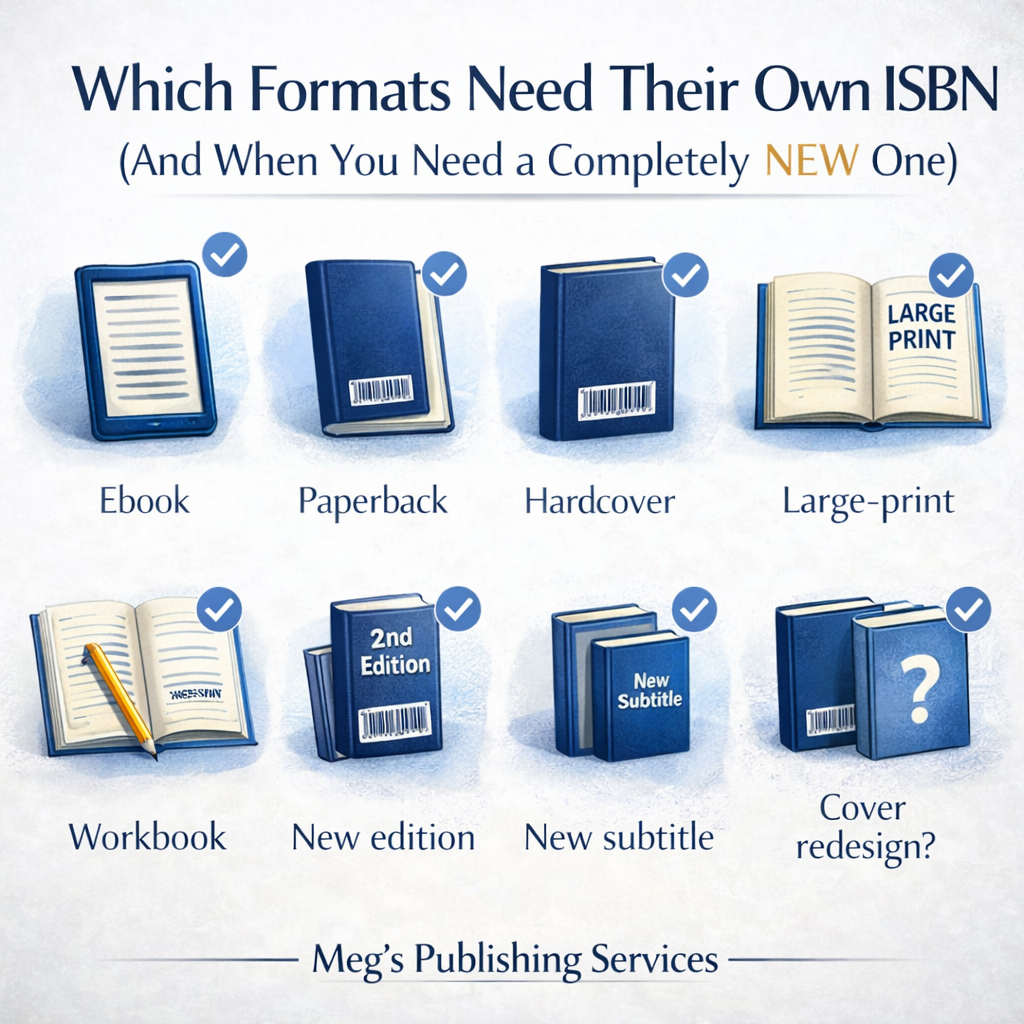
ISBN confusion is one of the biggest reasons authors make irreversible publishing mistakes.
Not because the rules are hard.
Because no one explains them clearly.
So authors guess.
Or reuse numbers.
Or assume “small changes don’t count.”
They do.
This one decision clears up most of the confusion in one go.
The rule most authors never hear
An ISBN does not belong to a book idea.
It belongs to a specific product version.
Change the product in a way that affects how it is sold, cataloged, or distinguished, and you need a new ISBN.
Let’s break it down by format and scenario.
Ebook
Ebooks do not require an ISBN on Amazon.
That part is true.
But if you distribute ebooks beyond Amazon, many platforms expect one.
Important detail:
An ebook ISBN must never be shared with a print version.
Ebook = separate identity.
Paperback
A paperback always needs its own ISBN.
If your paperback exists as a sellable product, it must have a unique identifier.
Paperback and hardcover are never the same book in the global system, even if the content is identical.
Hardcover
Hardcover requires its own ISBN, separate from paperback and ebook.
Different binding.
Different price point.
Different retail classification.
Same content does not mean same identity.
Large print
Large print is a different reading experience.
Larger trim.
Different pagination.
Different audience expectations.
That makes it a different product.
Large print always needs its own ISBN.
Workbooks and companion books
If it has:
A different title
A different purpose
Interactive content
Separate sales intent
Then it is not an edition.
It is a new book.
New book equals new ISBN.
Even if it supports another title.
New edition
A new edition requires a new ISBN when the changes are meaningful.
Meaningful changes include:
Updated content
Added or removed chapters
Rewritten sections
New structure or sequencing
Minor typo fixes do not count.
Substantial revisions do.
If readers would experience it differently, the system treats it differently.
New subtitle
This is where authors get sloppy.
A subtitle change that:
Repositions the book
Targets a new audience
Changes the promise
Is not cosmetic.
That is a new market signal, and it requires a new ISBN.
Tiny wording tweaks for clarity may not.
Strategic repositioning absolutely does.
Trim-size changes
Trim size changes the physical product.
Different dimensions.
Different spine width.
Different shelving classification.
That is a new ISBN.
Cover redesign
A cover redesign alone does not require a new ISBN.
Same trim size.
Same interior.
Same edition.
No problem.
But if the redesign comes with:
A new subtitle
A new edition
A format change
Then the ISBN must change too.
The cover is not the trigger.
The product change is.
The mistake that causes most damage
Authors reuse ISBNs across formats or editions because “it’s the same book.”
The system does not agree.
This creates:
Catalog confusion
Distribution errors
Retailer mistrust
Long-term cleanup nightmares
Fixing it later often means republishing.
Final thought
ISBN rules are not arbitrary.
They exist to protect clarity.
Once you understand that an ISBN belongs to a specific version, not an abstract book idea, the confusion disappears.
If you are unsure whether your current formats and editions are set up correctly, pause before publishing further.
If you want your formats, editions, and ISBN structure handled cleanly from the start, reach out to Meg’s Publishing Services.
We help authors avoid mistakes that follow books for life.